
The Machine
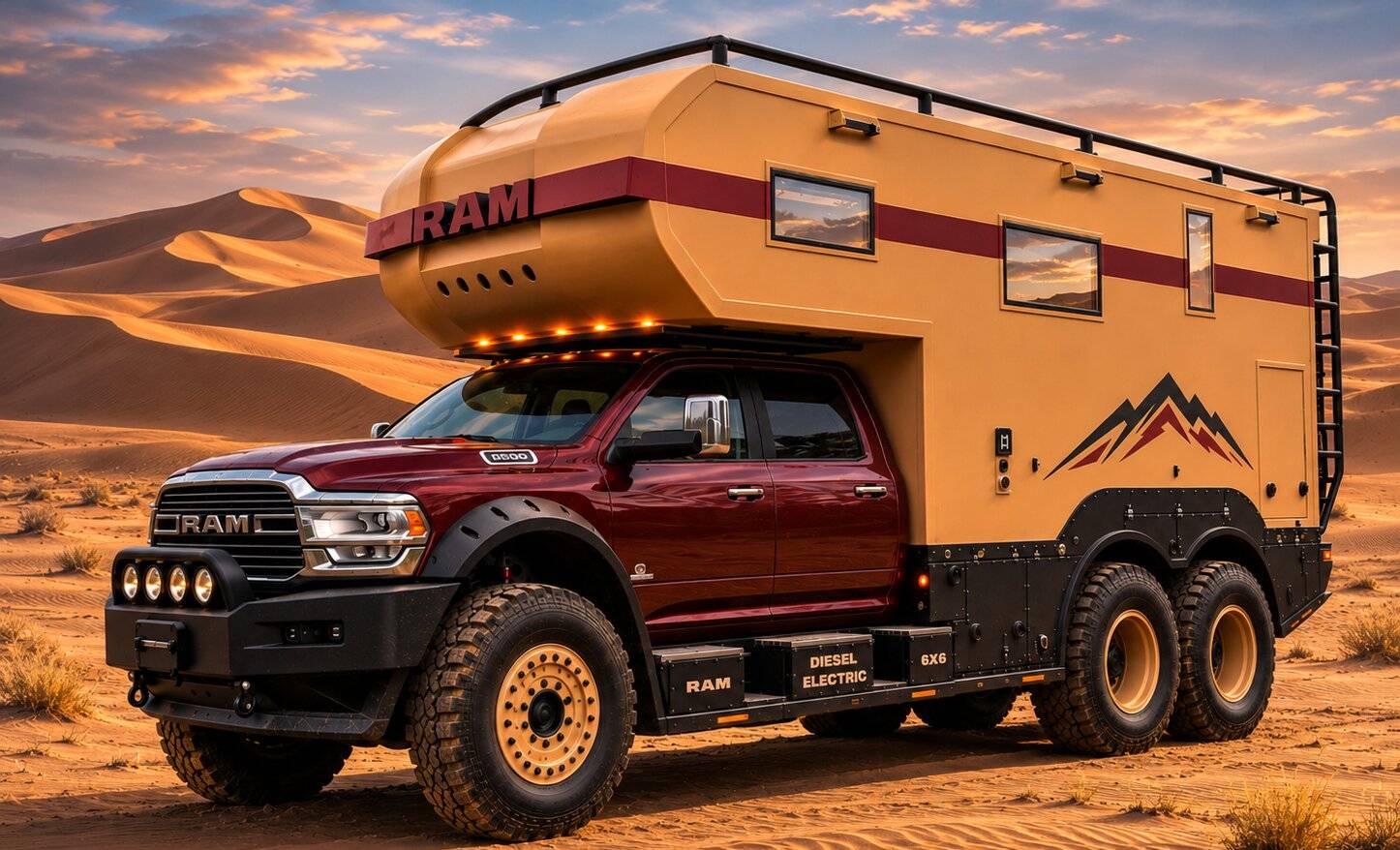
A purpose-built 6x6 expedition platform.
The Concept
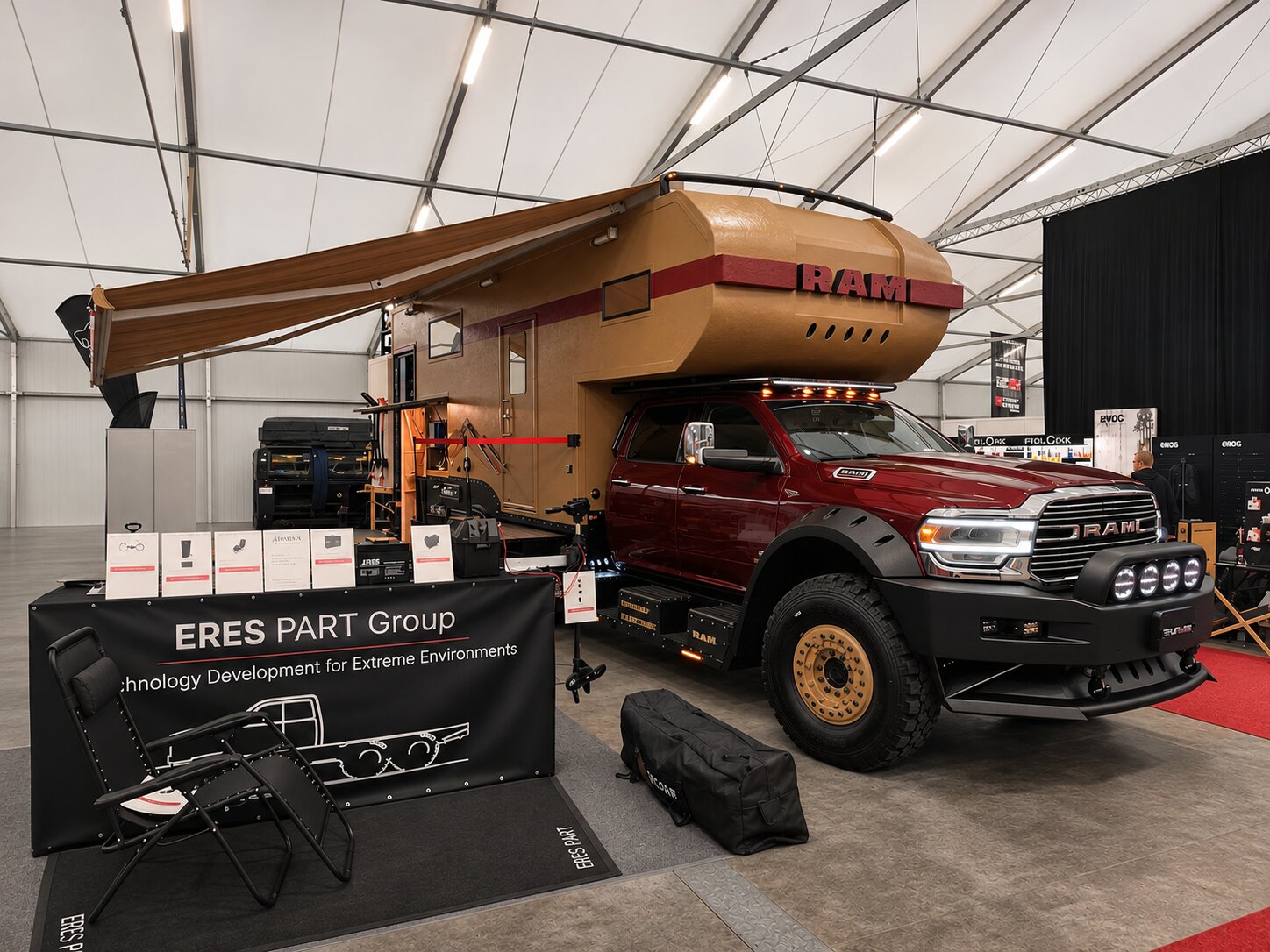
A hybrid where diesel never stops being the drivetrain. A RAM 5500 Heavy Duty converted from 4×4 to 6×6. The electric motor — 860 Nm, 112 kW — assists where it makes sense: in slow terrain, pulling away, under regeneration. But the vehicle is never dependent on it.
A design built to be repaired, not replaced. Every part we designed and built ourselves — the body, the structure, the fittings, the interior — can be remade in an ordinary workshop anywhere in the world. No laser, no CNC, no proprietary tooling. The whole build is demountable and nothing is bonded shut. Production components keep their own service networks; everything that is ours, you can fix yourself.
A workbench with a vice. Fold-down top, vice, 230 V sockets, USB and compressed air right at the working surface. Most expedition vehicles solve where to store tools. This one solves where to work with them.
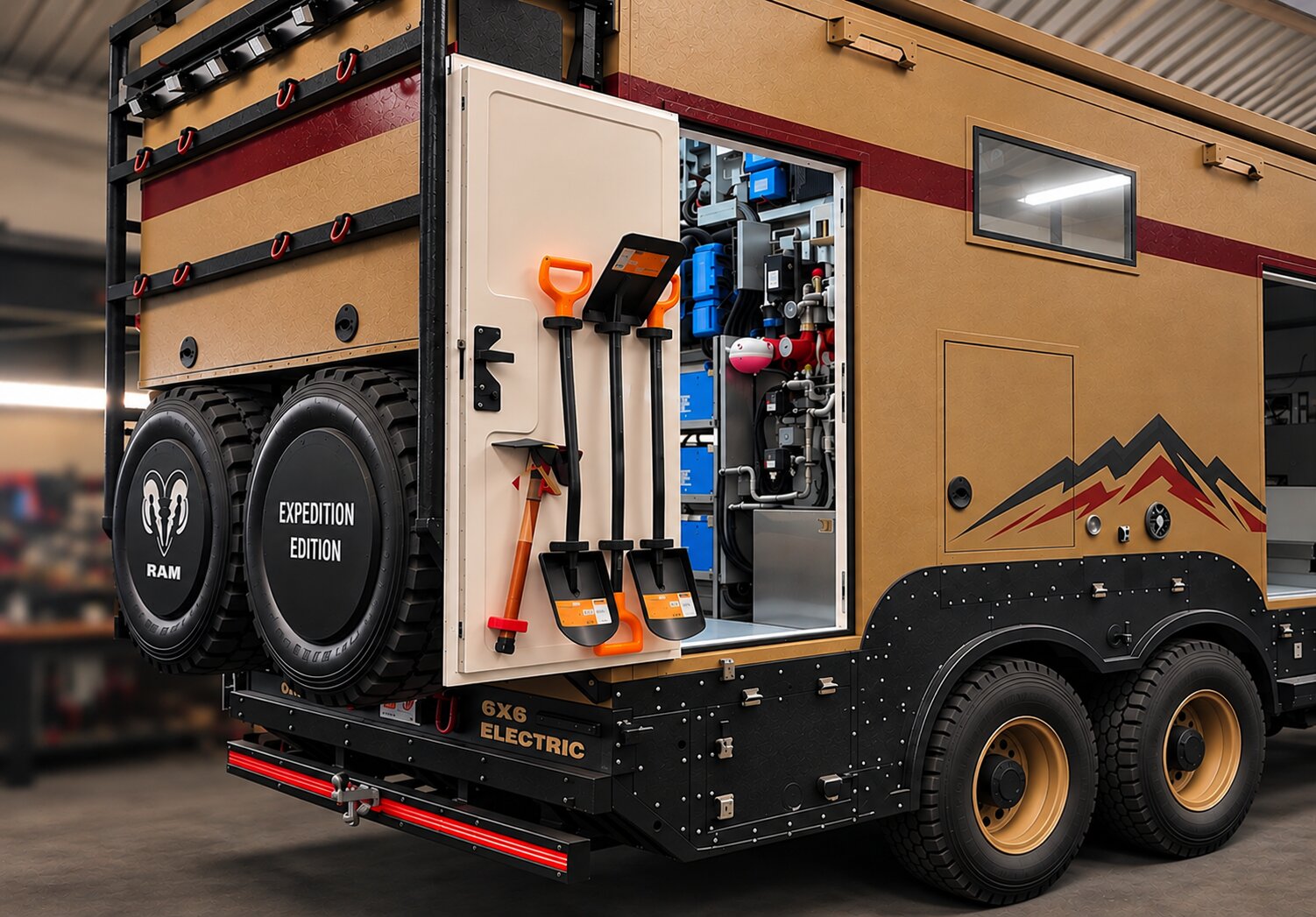
Lit chassis. When a repair is needed at night, you are not working by headtorch.
Stainless steel AISI 304 subframe with redundant body-to-chassis connection — three independent load paths.
Meridian Chasis
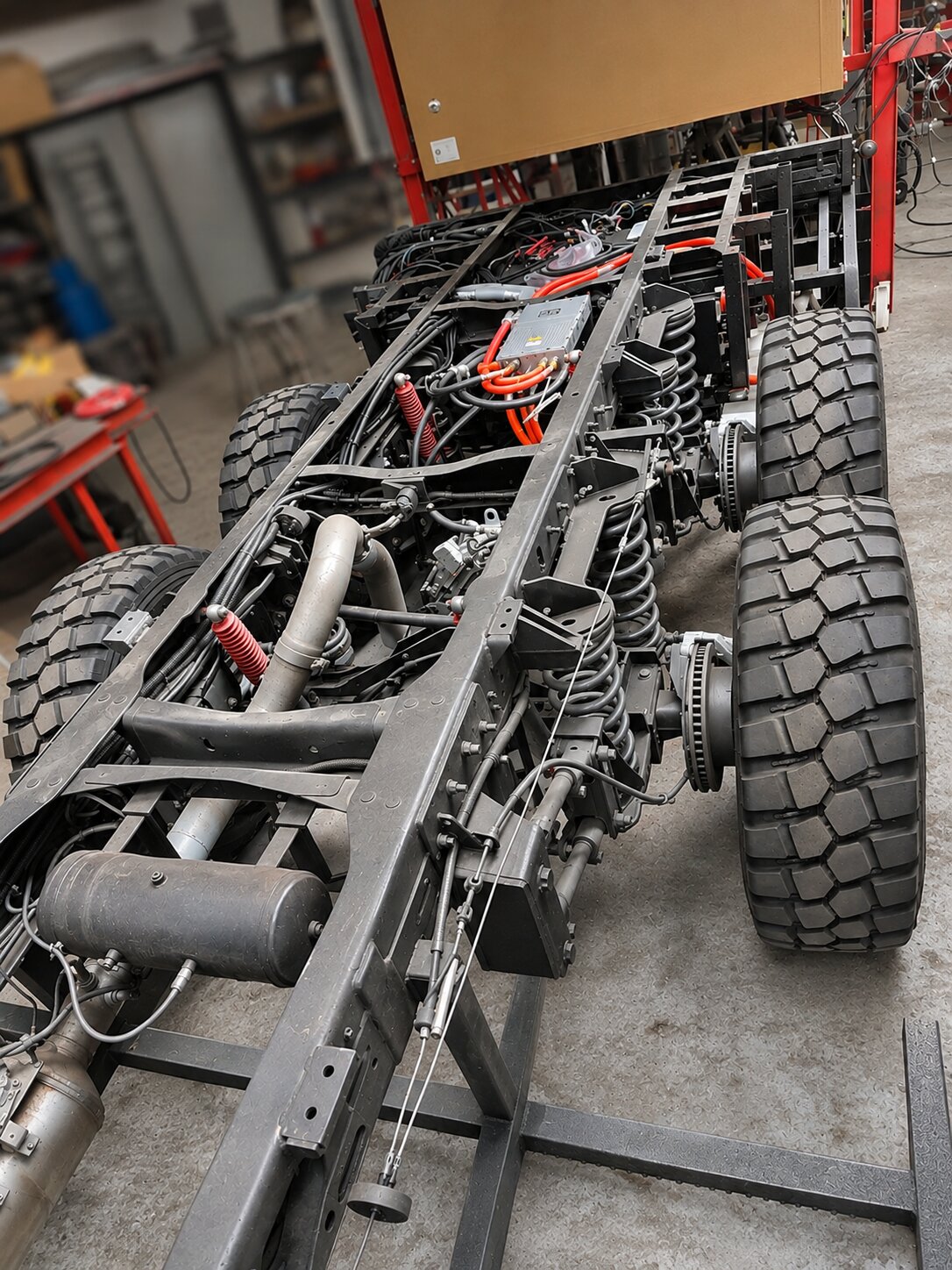
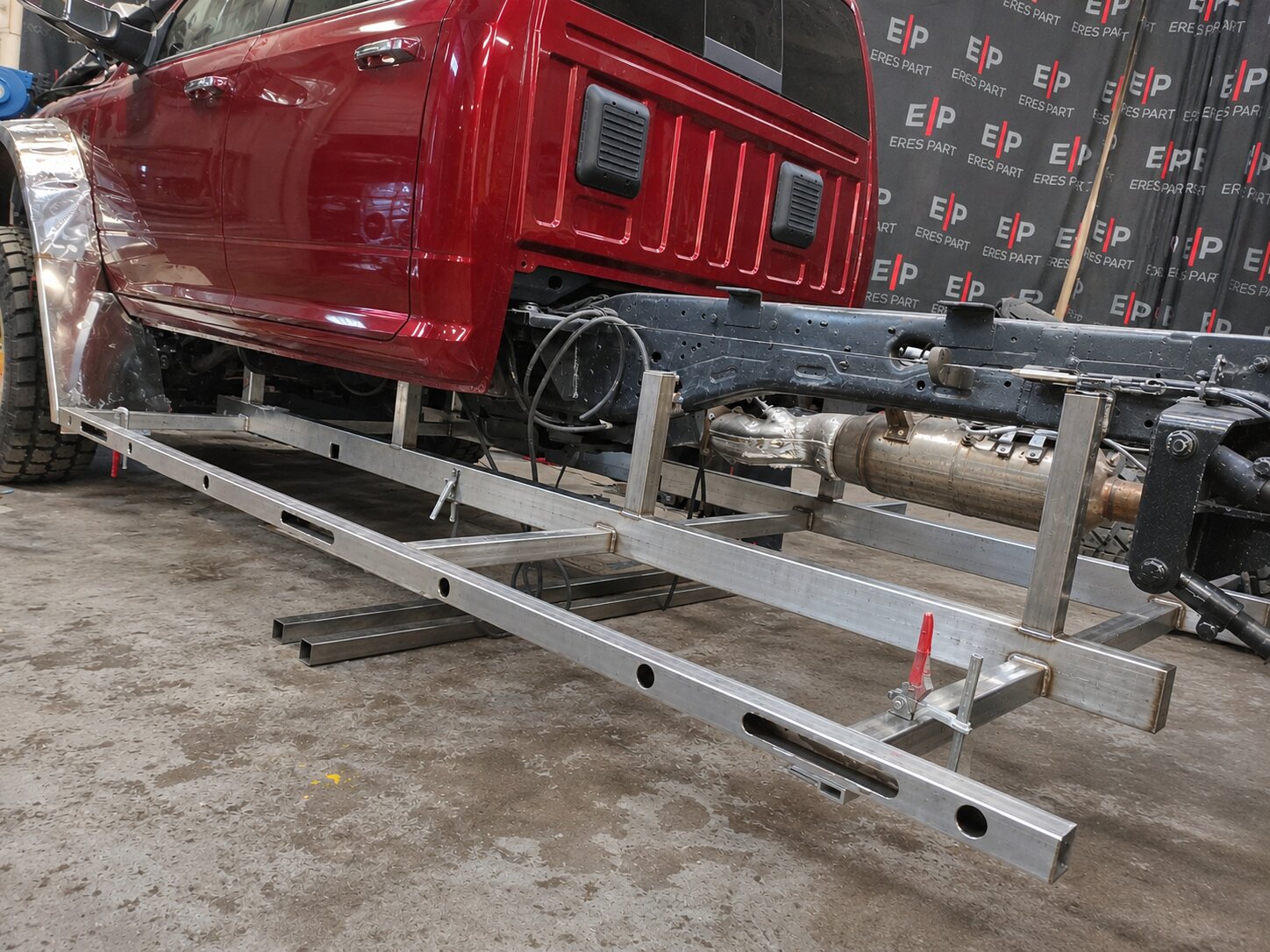
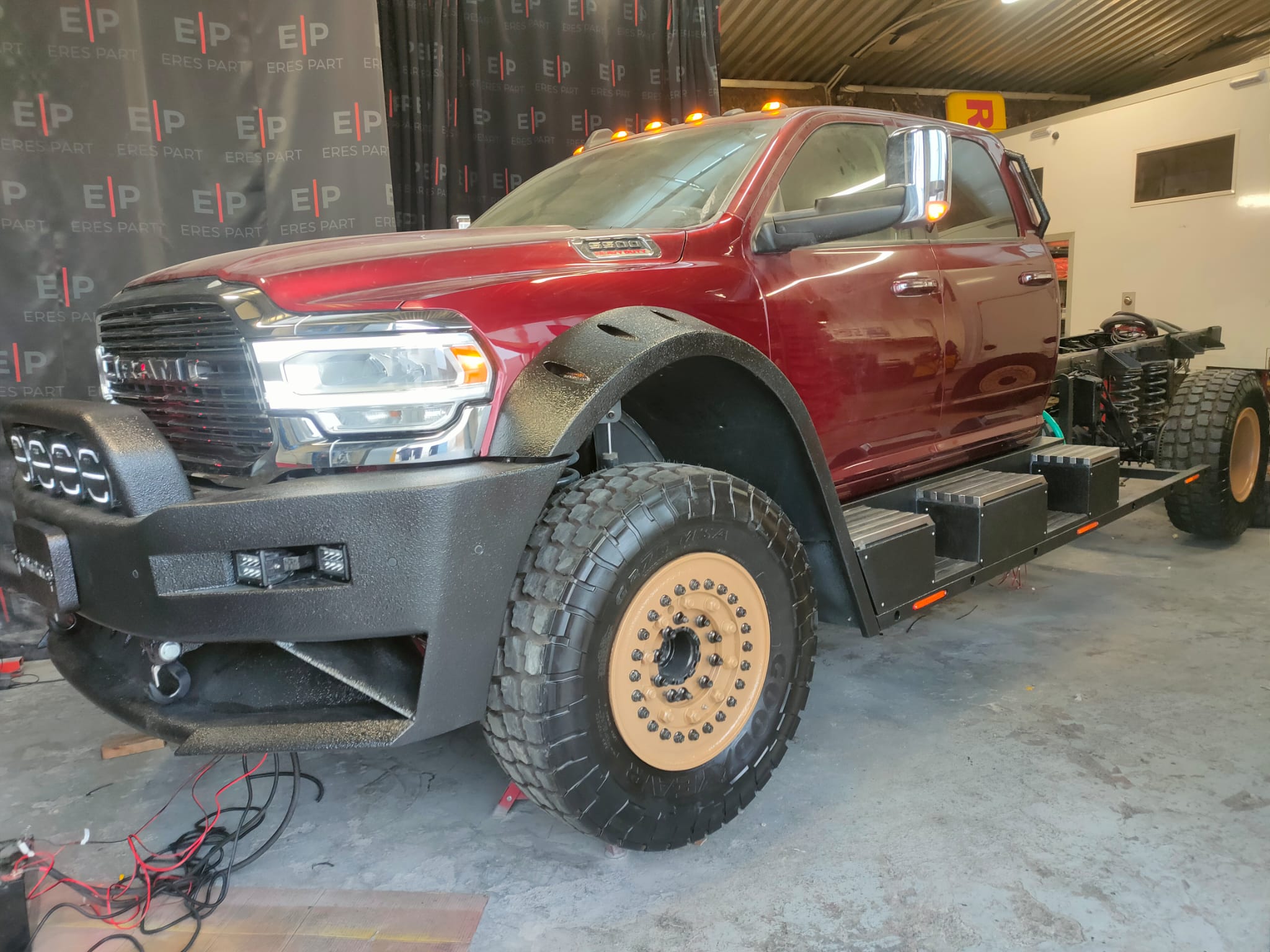
The Meridian does not merely sit on the RAM 5500 chassis — it fundamentally redefines it. To support a gross vehicle weight of 17 tonnes while carrying a fully integrated habitat, massive fuel and water reserves, and a traction battery, ERES PART Group engineered a massive additional steel subframe that bolts to the factory rails and extends rearward to cradle the third axle.
This is not a bolt-on accessory; it is a stressed structure that transforms the pickup chassis into a heavy-duty expedition platform, distributing concentrated loads across the entire length of the frame rather than allowing the habitat to flex independently from the cab.
At the rear, a custom-fabricated third bridge carries the electric axle and its associated traction battery, housed in a protective stainless-steel cradle beneath the habitat floor. The suspension was converted from factory leaf springs to a heavy-duty independent coil system with upgraded dampers, providing the articulation and impact absorption necessary for a vehicle that will spend its life on Bolivian scree and Siberian ruts.
Coil springs were chosen over air suspension for reliability on long journeys. Kelderman 4-link geometry is used on both axles with a reinforced Panhard rod. The assembly rolls on lightweight Hutchinson aluminum beadlock wheels with 365/80 R20 tyres, chosen for their ability to maintain traction at absolute low pressures and to survive high-speed blowouts without catastrophic separation.
Auxiliary air bags provide levelling adjustment of up to 20 cm, and an electric strut braces against the ground when parked so the vehicle does not rock. Approach angle is 19.5°, breakover 15.9°, departure 17.9°. Wading depth is 60 cm, with traction cooling fans that can be disconnected for water crossings. Every element of this modification was driven by a single number: 17,000 kilograms. At that weight, there is no margin for compromise. The frame must not flex. The suspension must not bottom. The wheels must not fail. The Meridian chassis is not a modified truck. It is a ground-up structural solution for a weight class that no factory pickup was ever designed to occupy.
Coil Spring Suspension
We replaced the factory leaf spring setup with a heavy-duty independent coil spring system, built with substantially upgraded coils and high-performance dampers to manage the habitat's unique weight distribution. The difference is not merely comfort; it is capability. The coil architecture allows each wheel to react independently to terrain, maintaining tire contact where a leaf-sprung axle would have one wheel dangling in the air. It absorbs impacts rather than passing them through the frame, and it provides a stable, predictable platform whether the vehicle is crawling over Siberian ruts or covering highway distances at speed.
The result is a suspension that works with the expedition mission instead of against it. The structure endures less fatigue. The crew arrives less battered. And when the path demands traction, the wheels stay planted. It was one of the most significant mechanical decisions in the build — not because it is visible from the outside, but because it determines whether the vehicle survives the journey in one piece.
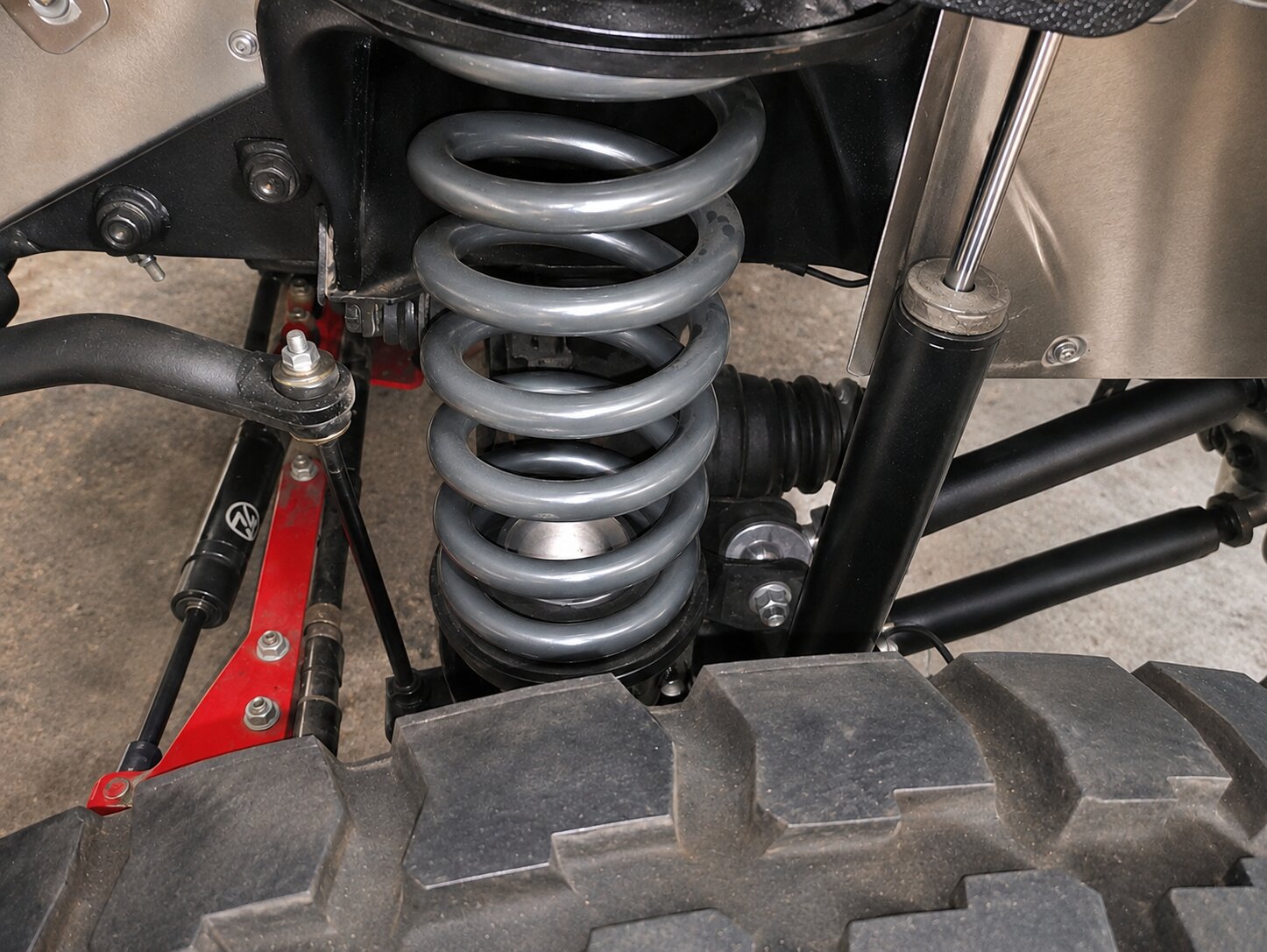
The RAM 5500 leaves the factory with leaf springs because it is designed to haul gravel and construction equipment — loads that do not care about ride quality, articulation, or what happens to a cabinet full of glassware after eight hours on a Bolivian washboard road. For an expedition vehicle carrying a permanent habitat, those leaf springs became a liability. They rode harshly when the chassis was not fully loaded, offered limited wheel travel when the trail turned uneven, and transmitted every impact directly into the living quarters. After thousands of kilometers, that vibration does not just bruise occupants — it loosens fasteners, cracks seams, and ages electronics prematurely.
Meridian's Electric 3rd Axle
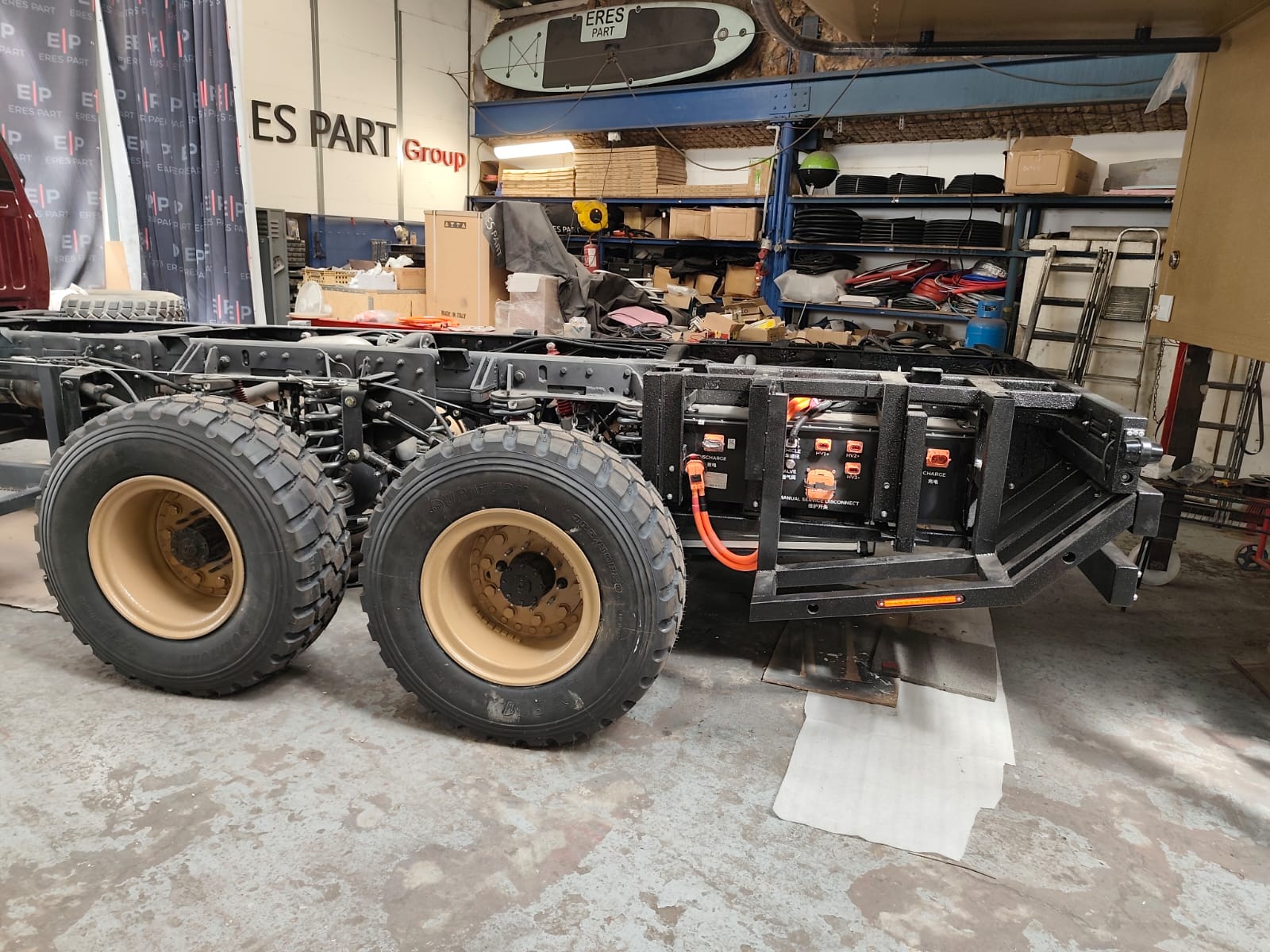
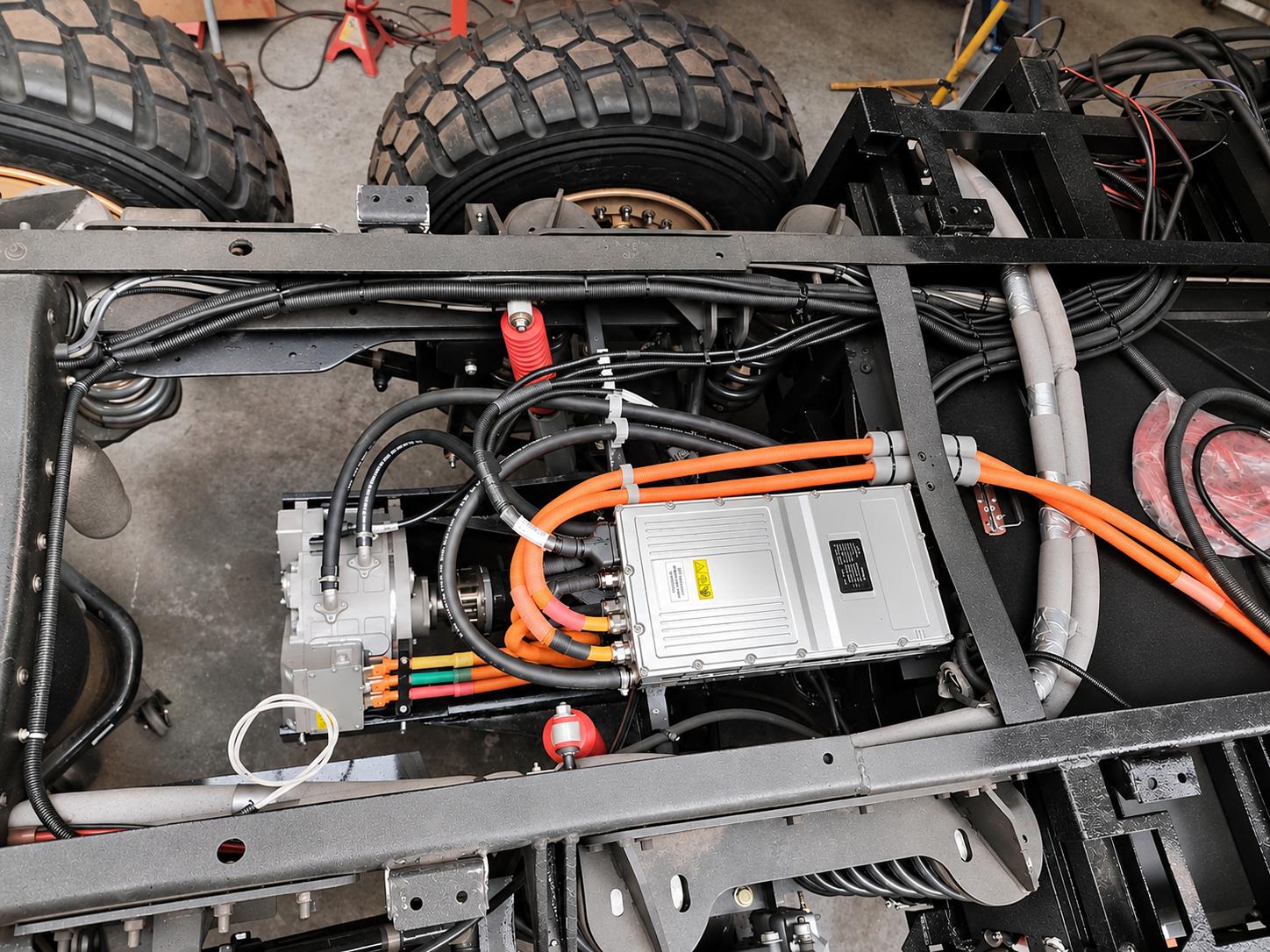
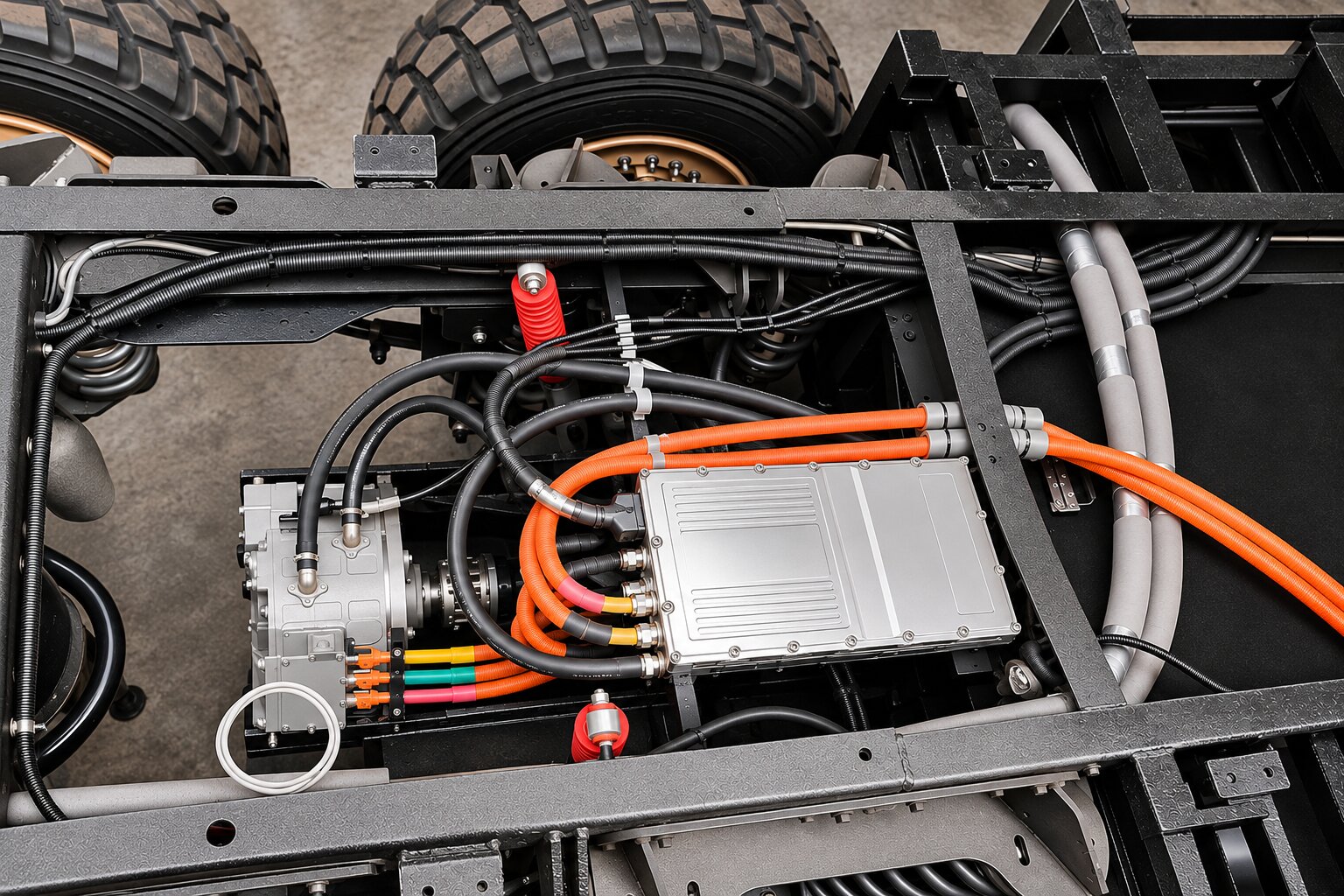
The third axle of the Meridian 6×6 is not a passive tag-along — it is an independent 112 kW electric drivetrain that thinks and reacts as part of a unified whole. To the driver, the integration is invisible. There is no secondary switch, no mode selector, no learning curve. Press the accelerator, and the vehicle moves. Press the brake, and it slows. Behind that simplicity lies a custom onboard driver computer running proprietary Meridian software over the standard CAN protocol, continuously balancing torque demand between the Cummins diesel front axles and the electric rear axle in real time.
Mechanically, the system centers on a high-torque electric motor delivering 860 Nm, mated to a standard RAM 5500 rear axle through a precision-machined adapter plate and a modified gearbox coupling. The motor is cradled within the chassis rails on a fabricated subframe, turning the factory axle housing into an electrically driven module without compromising its serviceability or structural integrity. Every bracket, every spline, every bolt pattern was engineered to align two powertrains that were never designed to meet.
Electrically, the axle is fed by a 540V high-voltage architecture routed through shielded orange cabling to a chassis-mounted inverter and motor controller. The "secret sauce" is not the hardware — it is the software layer that translates the traction controller's language into the native dialect of the RAM drivetrain computer and transmission. Using CAN bus messaging, Meridian's control module manages torque distribution, regenerative braking, and thermal protection seamlessly. The result is a 6×6 that behaves like a single organism, even though its heart is diesel and its hind legs are electric.
Hutchinson Beadlock Wheels
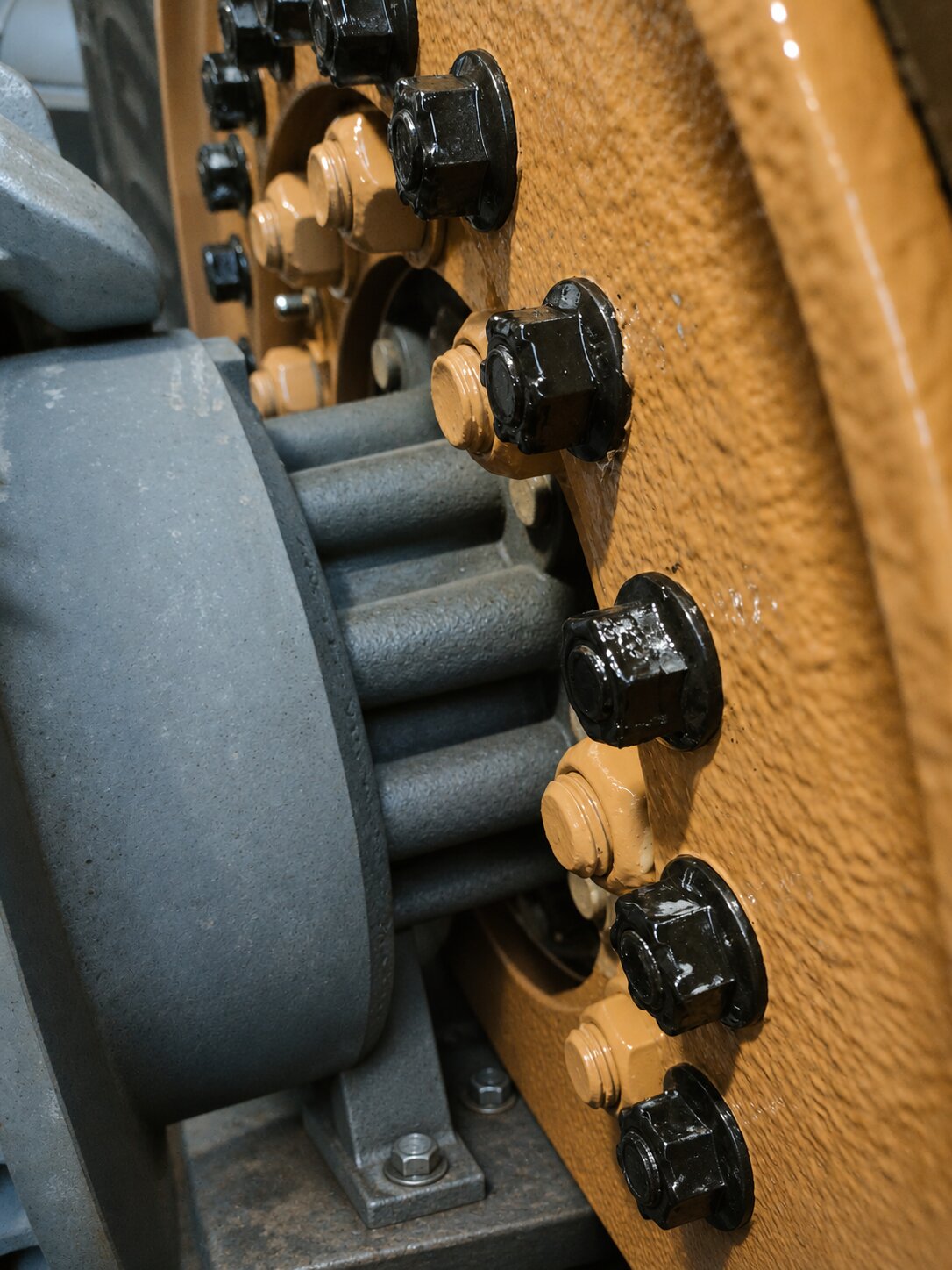
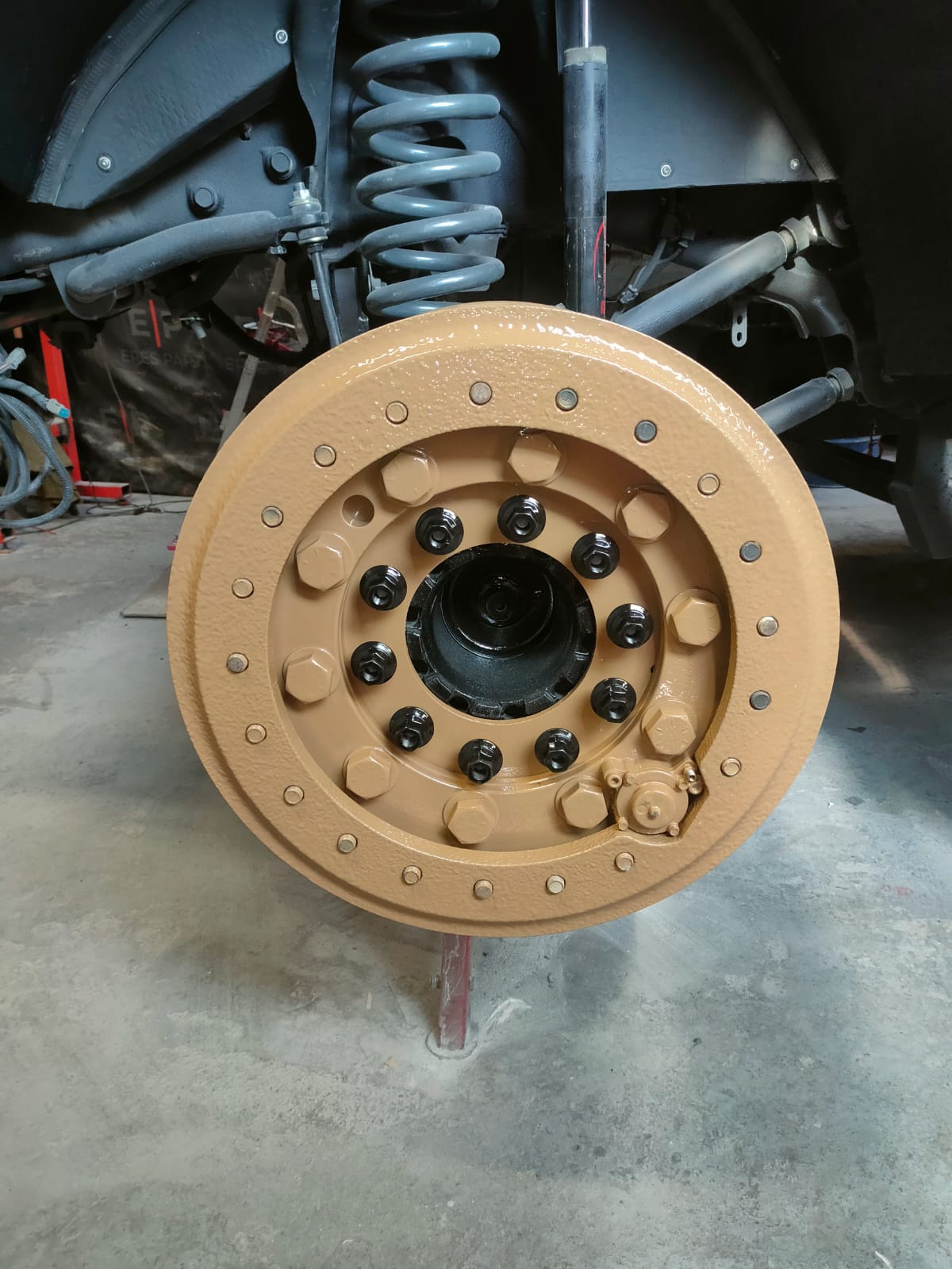
The Meridian sits on lightweight Hutchinson aluminum beadlock wheels — a specification drawn from military logistics and desert-rally experience, not aftermarket fashion. At the core of the design is a machined barrel paired with a bolted outer ring that mechanically clamps the tire bead to the rim. This physical lock allows the tire to be run at absolute low pressures — down to 0.5 bar or lower — without the bead slipping or the tire de-beading under lateral load. In Namibian dunes or Bolivian scree, that low-pressure footprint transforms traction, letting the 6×6 float over surfaces where conventional rims would dig in and stall. The construction and redundant sealing geometry also provide superior air retention and protection against slow leaks caused by thermal cycling, corrosion, or rim impact deformation.
Range & Endurance
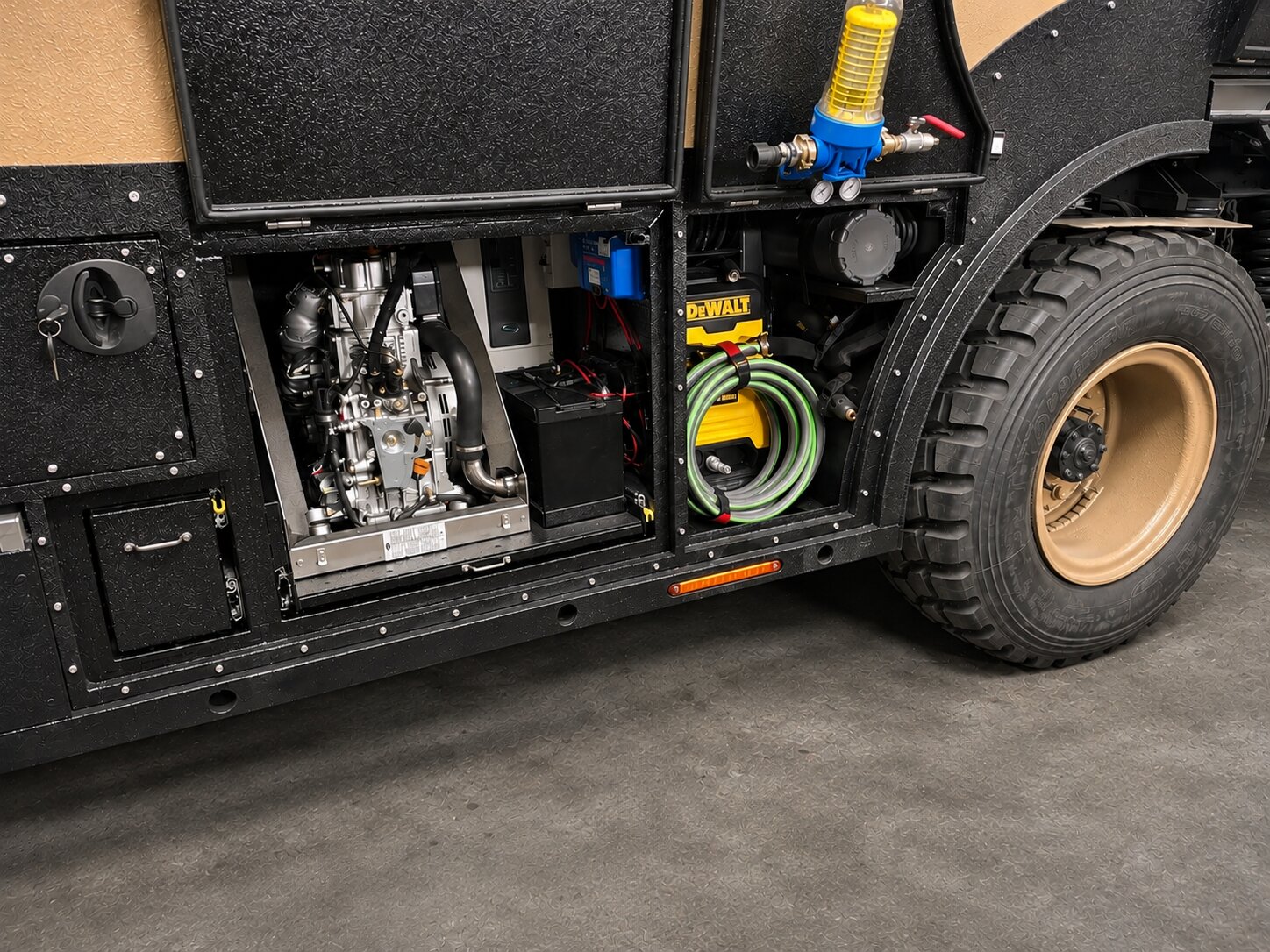
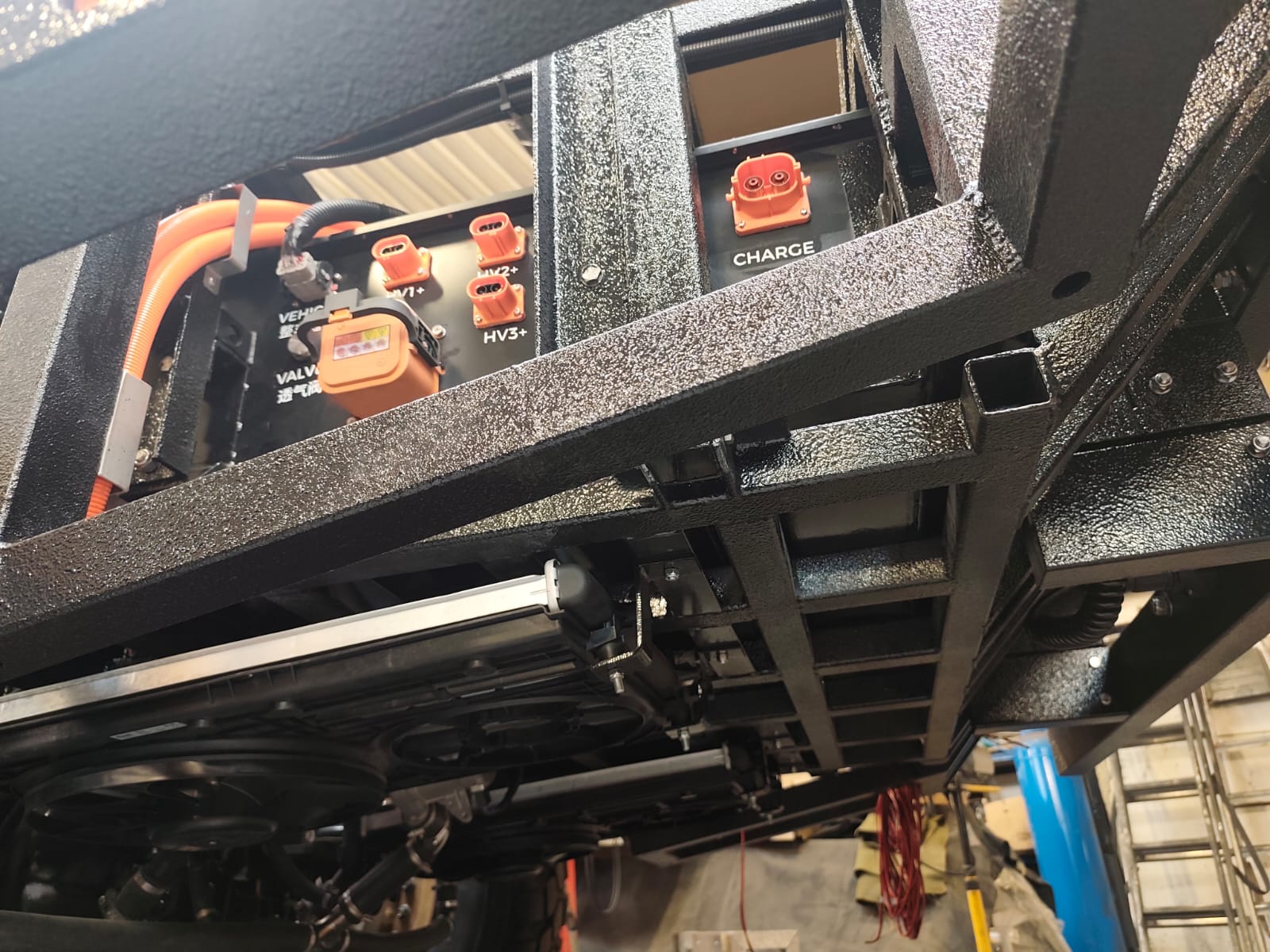
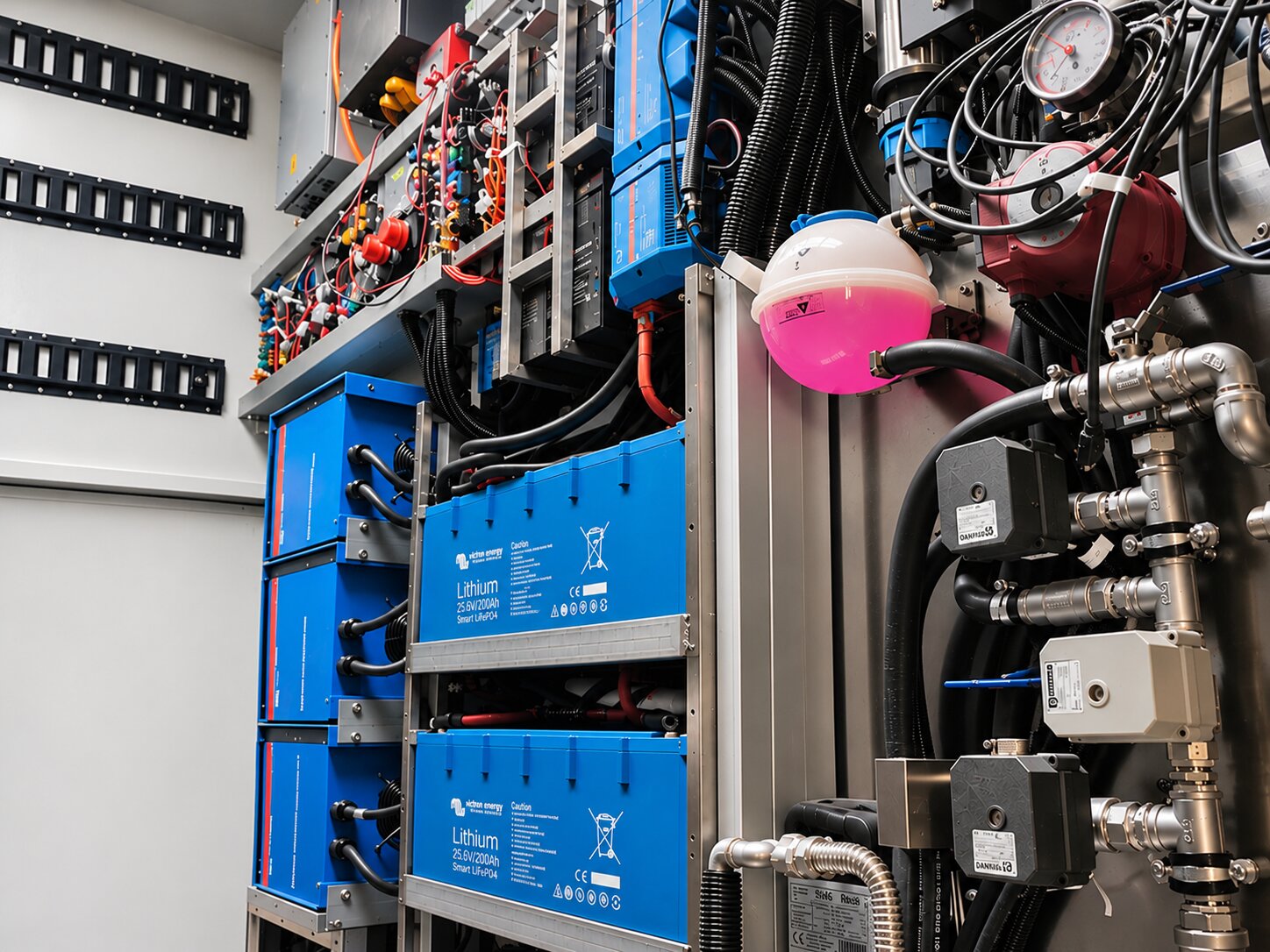
The Meridian carries 650 liters of diesel and a 560V / 125 Ah traction battery with a total capacity of 70 kWh. Together with a 15.4 kWh living bank, the vehicle stores 85 kWh of electrical energy on board — roughly what twenty-eight typical motorhomes carry between them. Based on preliminary engineering calculations, we estimate a conservative driving range in excess of 2,000 kilometers. This figure is intentionally conservative; real-world consumption validation will follow during our October expedition testing, and we expect the actual number to improve.
It is important to understand the architecture: the electric third axle is not a standalone drivetrain, and there is no separate "electric range." The 112 kW motor and 70 kWh traction battery operate as a diesel assistant — providing torque fill during acceleration, regenerative braking on descents, and reduced mechanical load on the Cummins during sustained high-demand operation. The diesel engine remains the primary propulsion source across all six wheels; the electric system simply makes it more efficient, more capable, and less stressed. Range is diesel-derived. The electrons just make the diesel go further.
In moderate conditions, the 85 kWh electrical store translates to ten to thirteen days of fully independent living without starting the onboard generator or connecting to a campsite, with air conditioning, induction cooking, and hot water all running as normal. In real heat, with the air conditioning operating continuously, that figure shortens considerably. We are honest about the compromise: comfort consumes electrons faster than moderation.
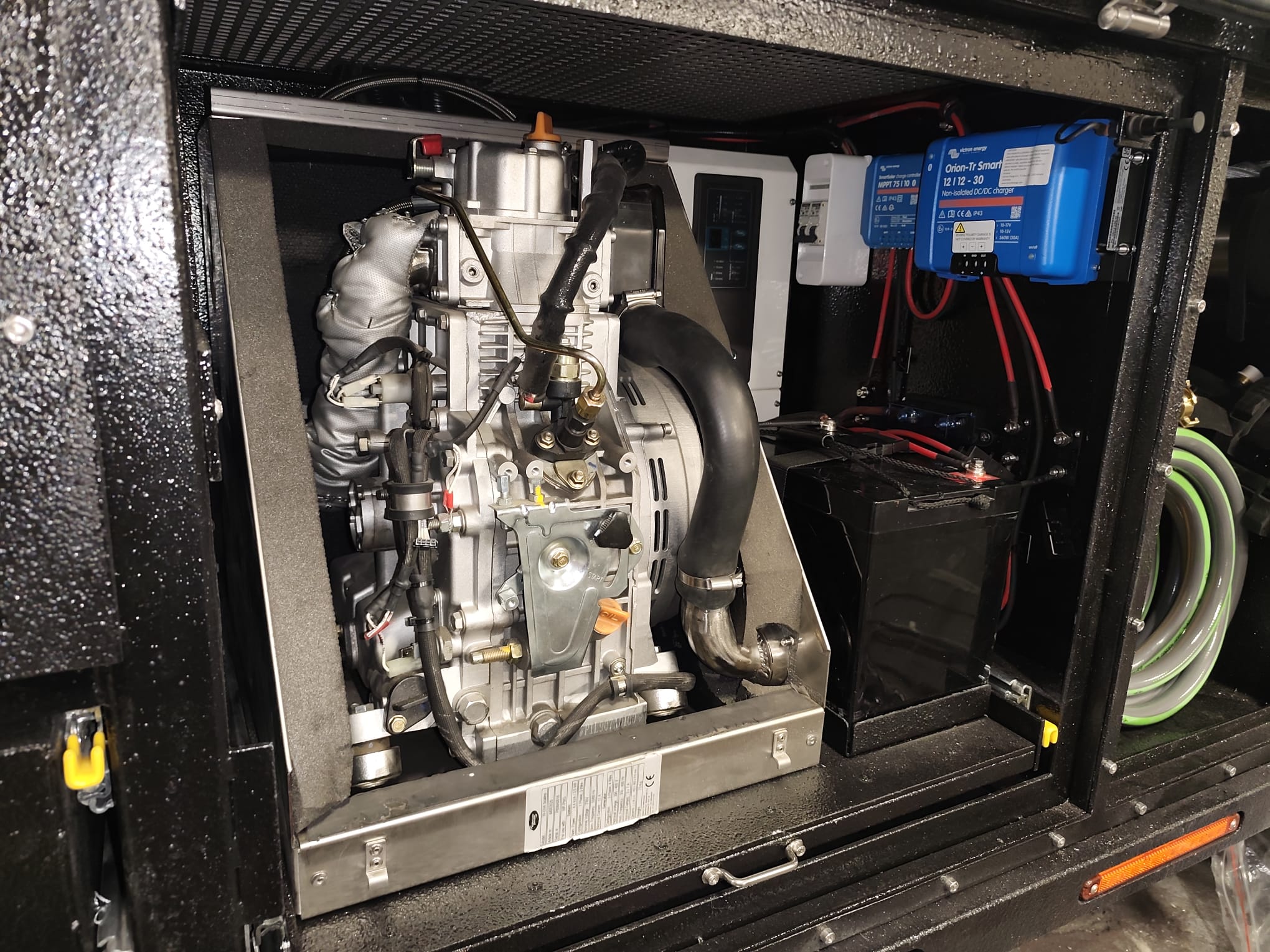
The same 650-liter diesel tank serves two masters. It can deliver over 2,000 kilometers of driving range, or it can power the onboard WhisperPower 4.4 kVA generator — certified for both 50 and 60 Hz — for roughly three quarters of a year of off-grid living. Same tank, different mission. Two entirely independent 230 V networks ensure that a failure on one circuit never leaves the habitat without power.
Charging
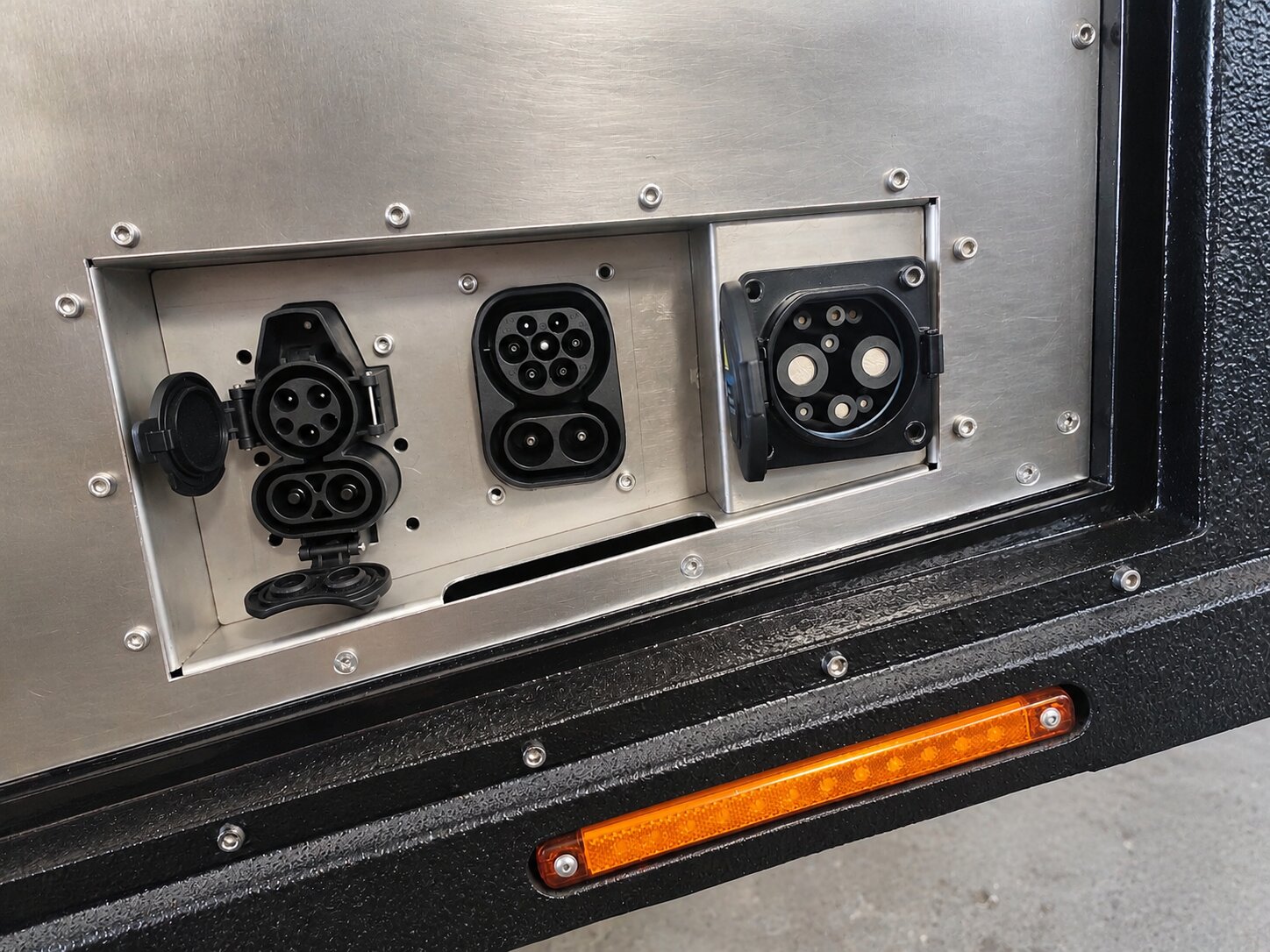
The Meridian's traction battery can be replenished almost anywhere on Earth. The AC input operates across 90 to 230 volts, accepting European, North American, and Japanese shore supplies without adapter compromises or voltage switching. For faster replenishment, three DC fast-charging sockets are fitted — CCS1, CCS2, and the Chinese GB/T standard — covering the charging infrastructure of North America, Europe, and Asia. A DC fast charge will take the battery from 10 to 80 percent in roughly 45 minutes.
It is critical to understand what this means in practice. A charged battery does not deliver a separate electric range — the Meridian has none. Instead, it delivers lower diesel consumption in demanding terrain, and it delivers silent energy to the living quarters for cooking, climate control, and water heating without starting the generator. The fast charging exists to keep the diesel-electric assistant fully armed and the habitat fully powered, not to replace the fuel tank. The diesel still carries you across continents. The electrons simply make each liter work harder.
Autonomy & Solar
Next to water, the electrical limit disappears altogether. In the mountains, regenerative braking from the electric third axle returns energy to the traction battery as you descend — you drive downhill and refill simultaneously.
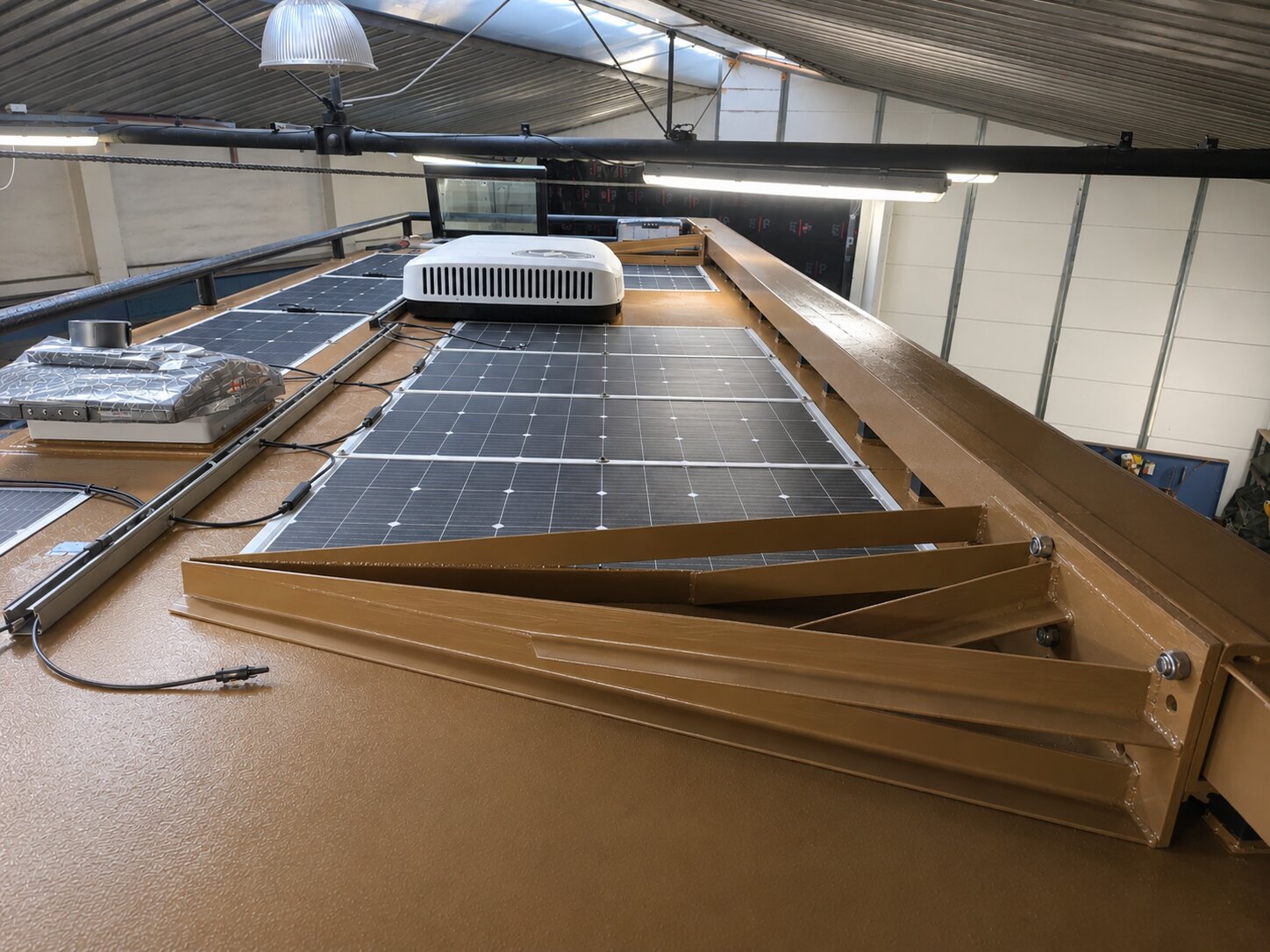
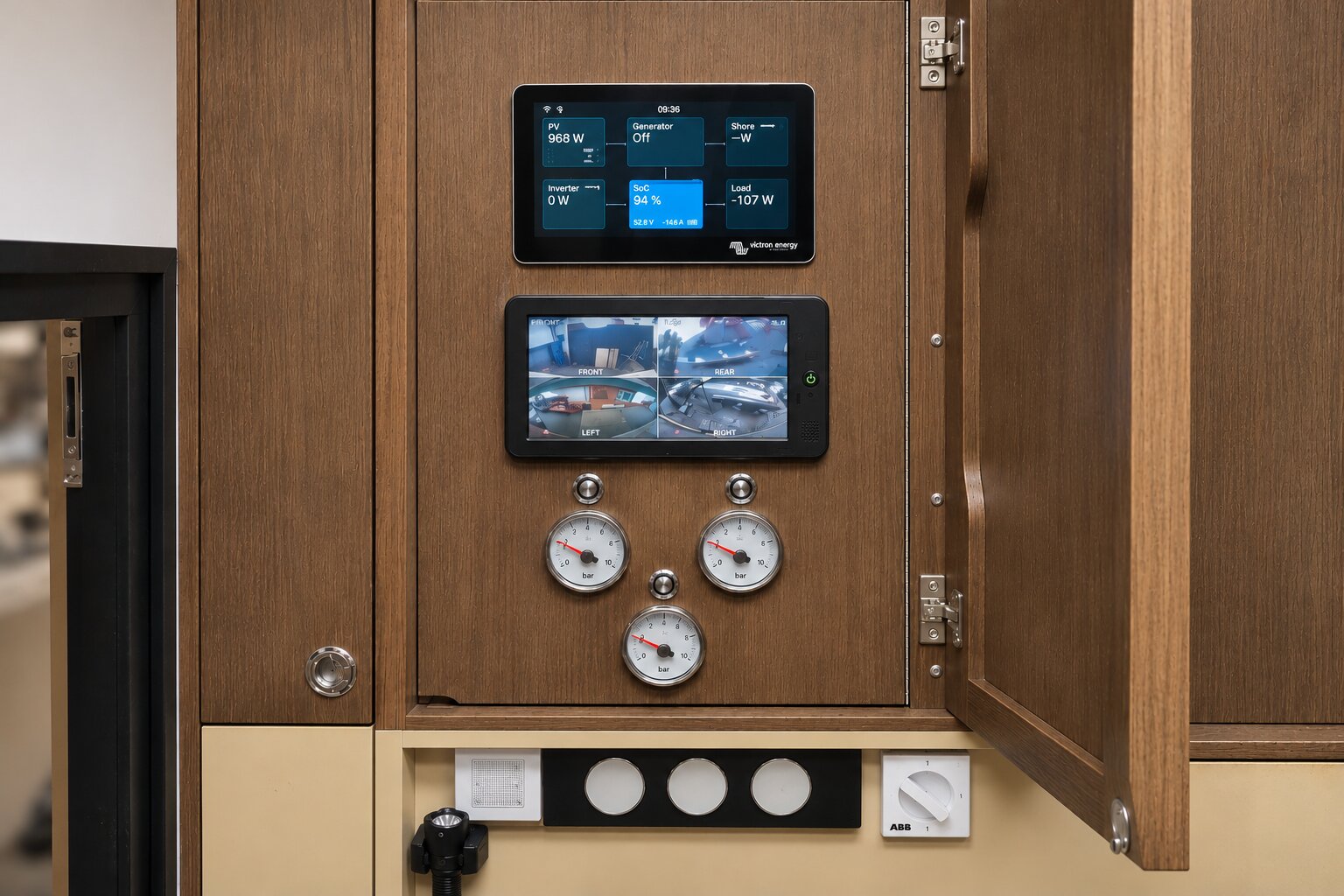
A 1kW photovoltaic array is integrated into the roofline across three independent strings. The primary array consists of nine 100 W panels wired 3S3P, managed by a Victron SmartSolar MPPT 150/35 controller feeding the 24 V living system. A separate 100 W panel on its own Victron MPPT 75/10 maintains the 12 V battery. Together they provide passive energy capture during stationary days, extending electrical autonomy without burning diesel or wearing the generator.
The Habitat
Designed with five-star hotel room comfort in mind, the habitat is engineered for planetary extremes and rated for operation from −30 °C to +50 °C.
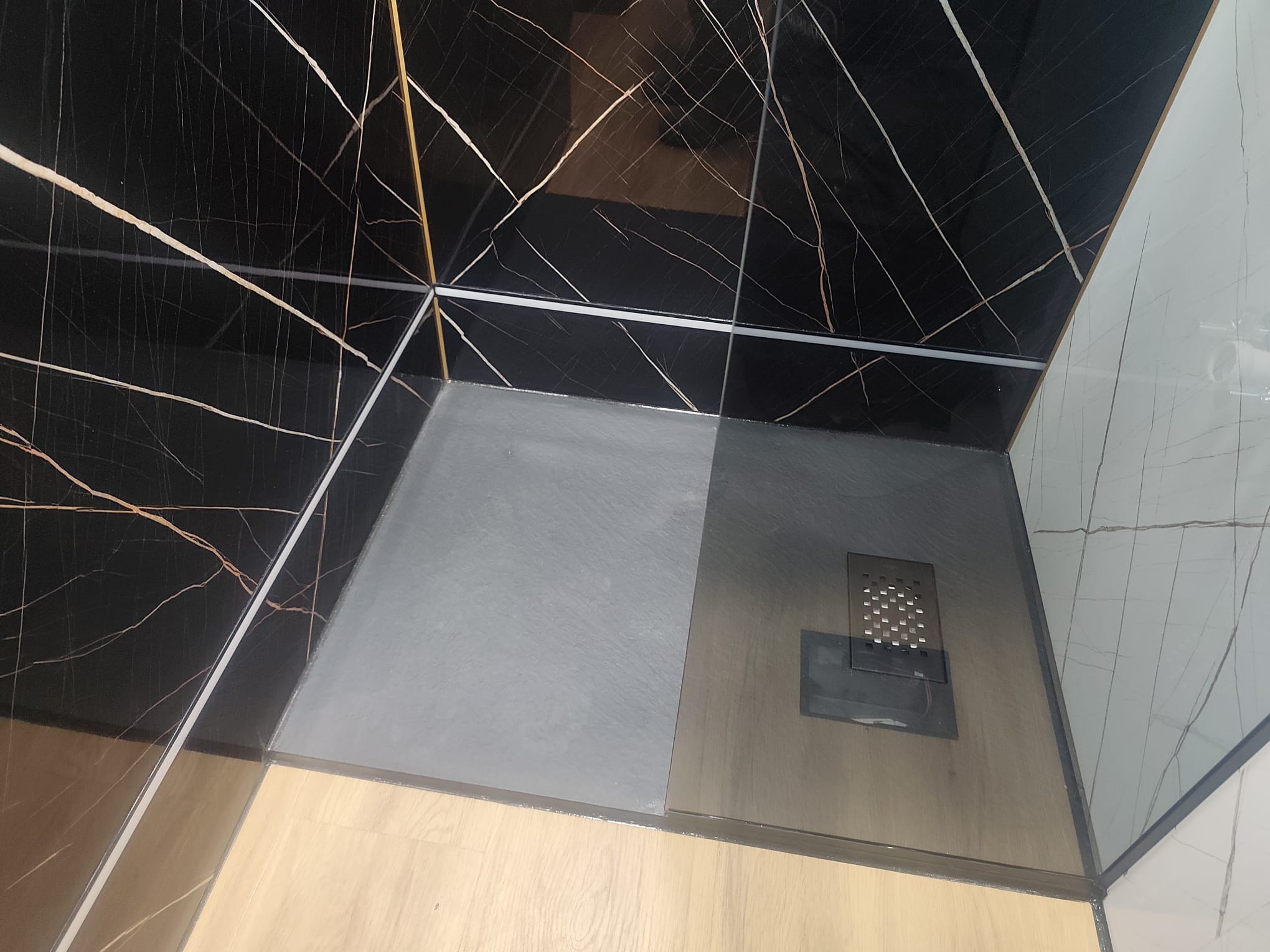
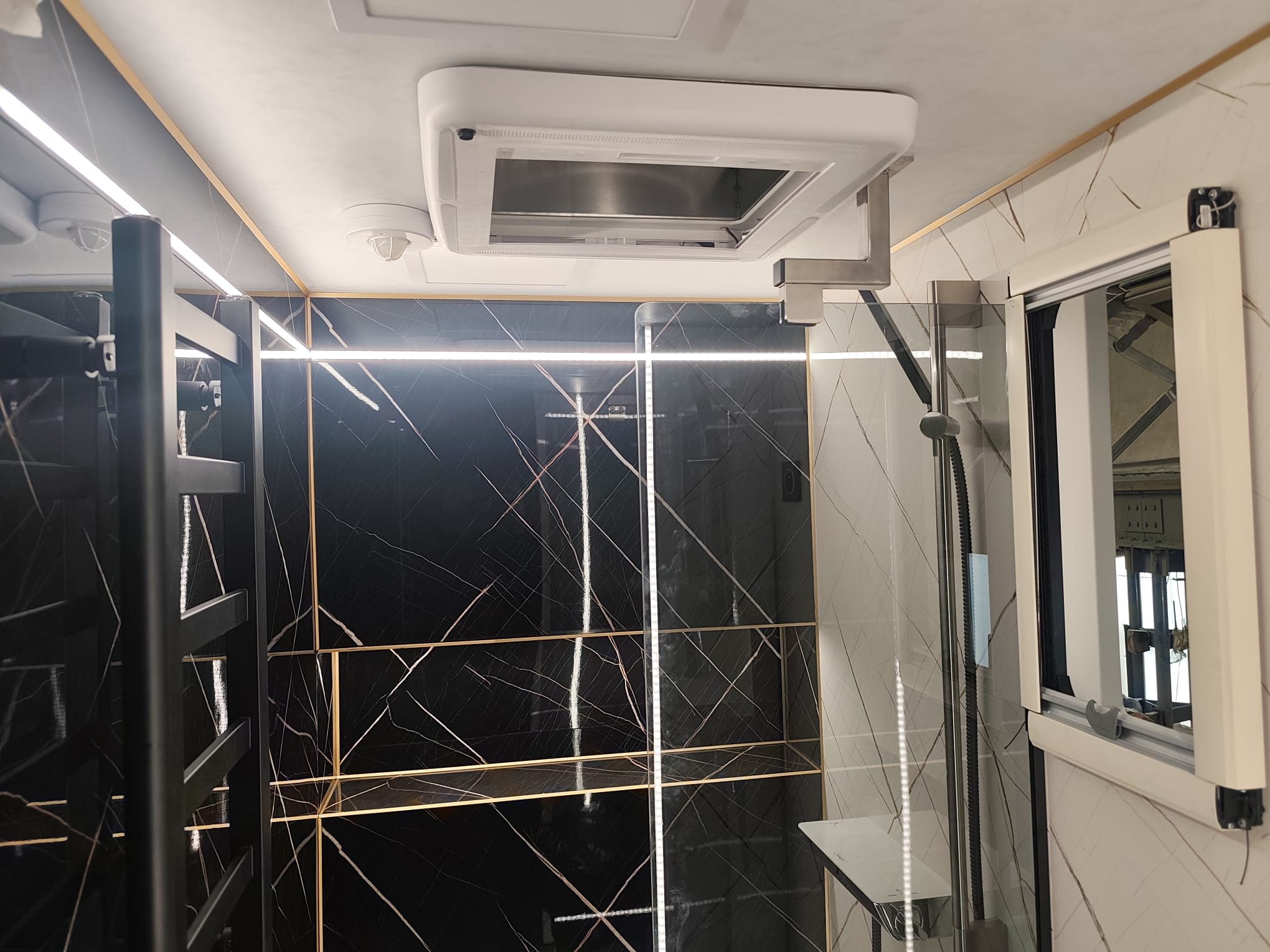
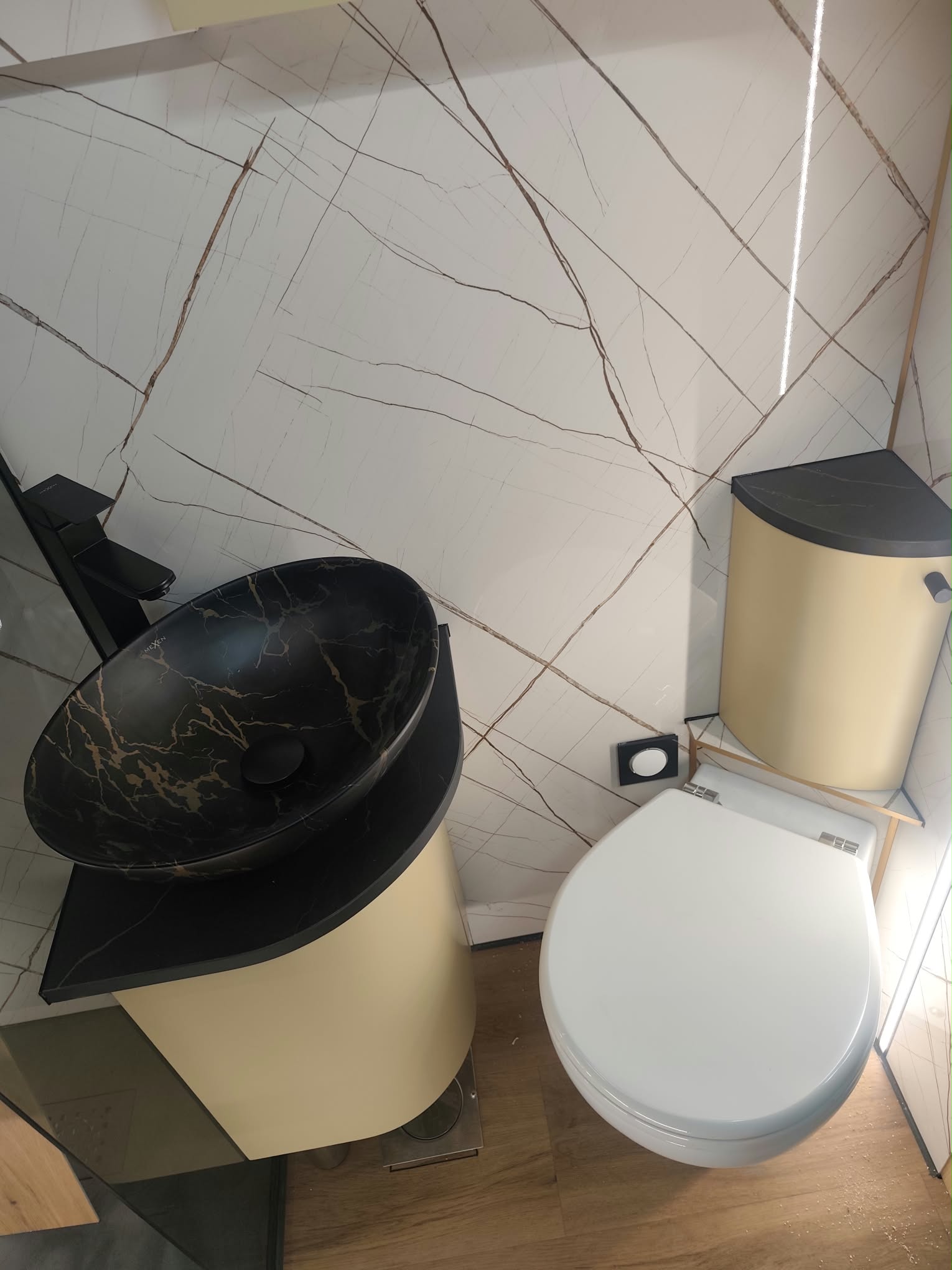
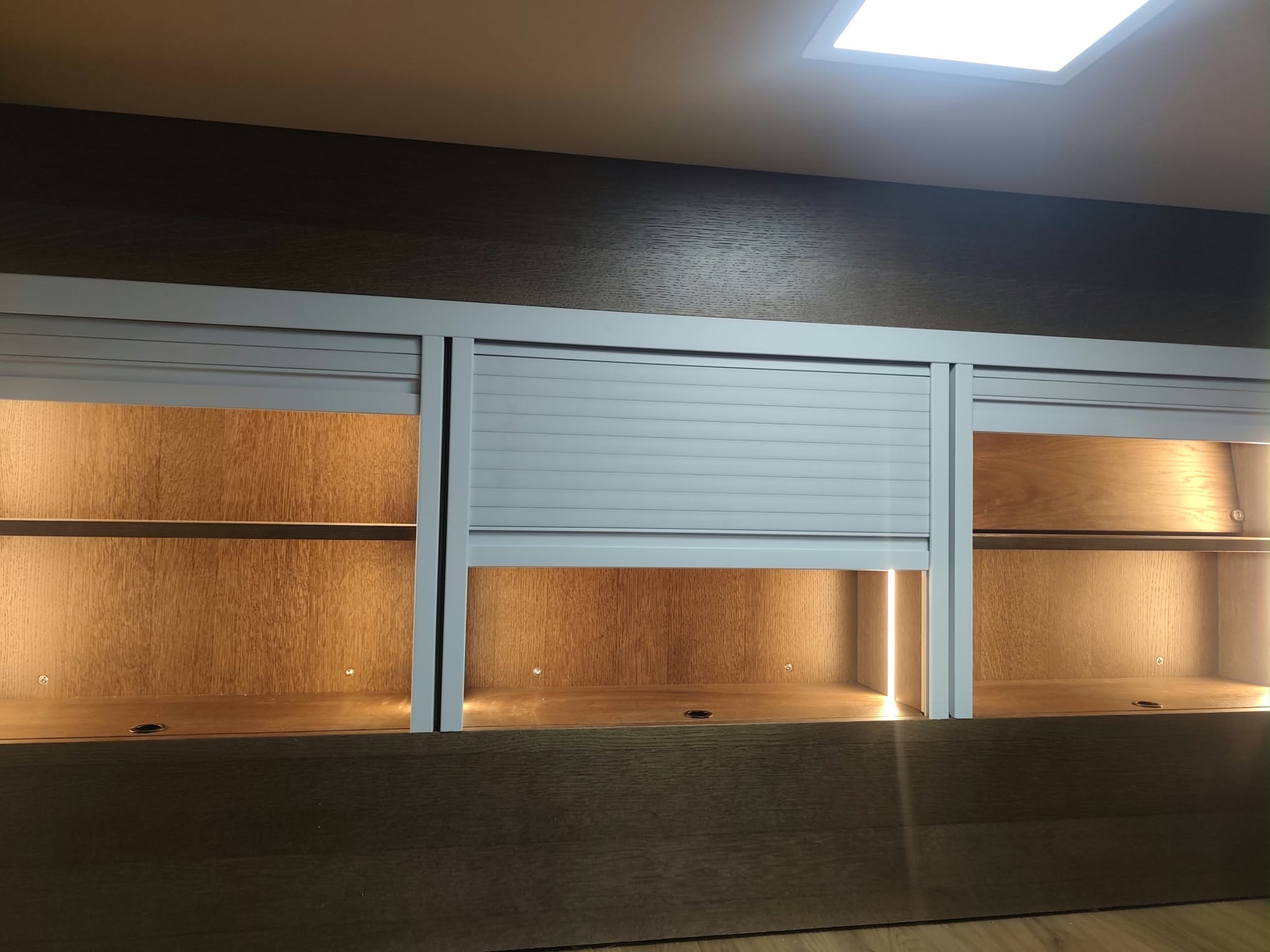
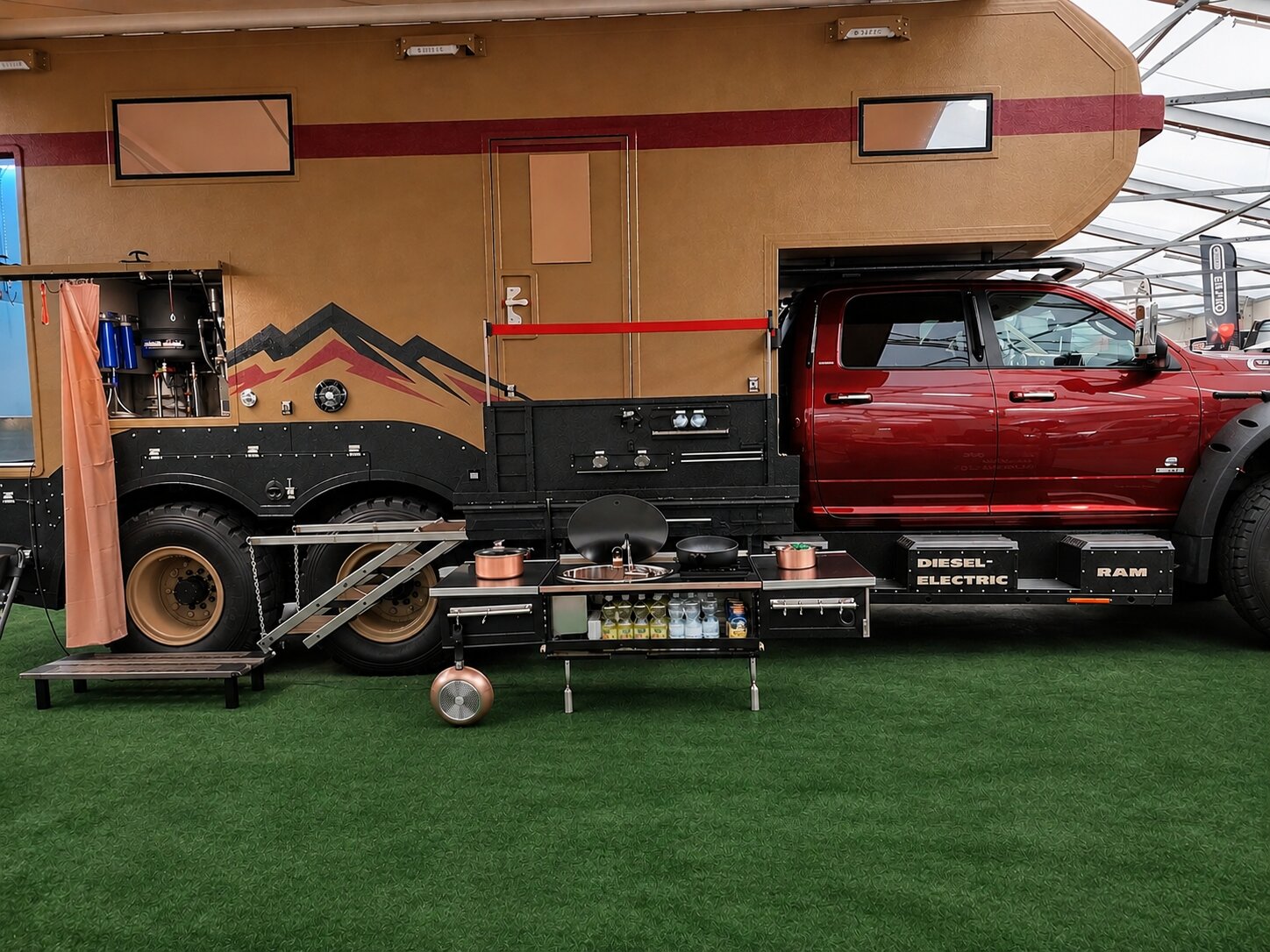
Step inside, and the wilderness disappears. The Meridian’s interior is conceived as a five-star suite that happens to travel, featuring a hotel-style shower with indoor and outdoor access, a marine-grade toilet, and a dual-purpose kitchen equipped with full-size electrical appliances that serve equally well beneath the awning or behind a sealed door. Underfloor and convection heating banish Patagonian mornings, while a powerful AC and intelligent ventilation maintain sanctuary in the Namibian summer. A compact washing machine, generous storage systems, and a dedicated garage for electric bikes keep expeditions civilized. At night, three berths and an overhead skylight place you beneath the stars without surrendering the duvet.
.jpeg)
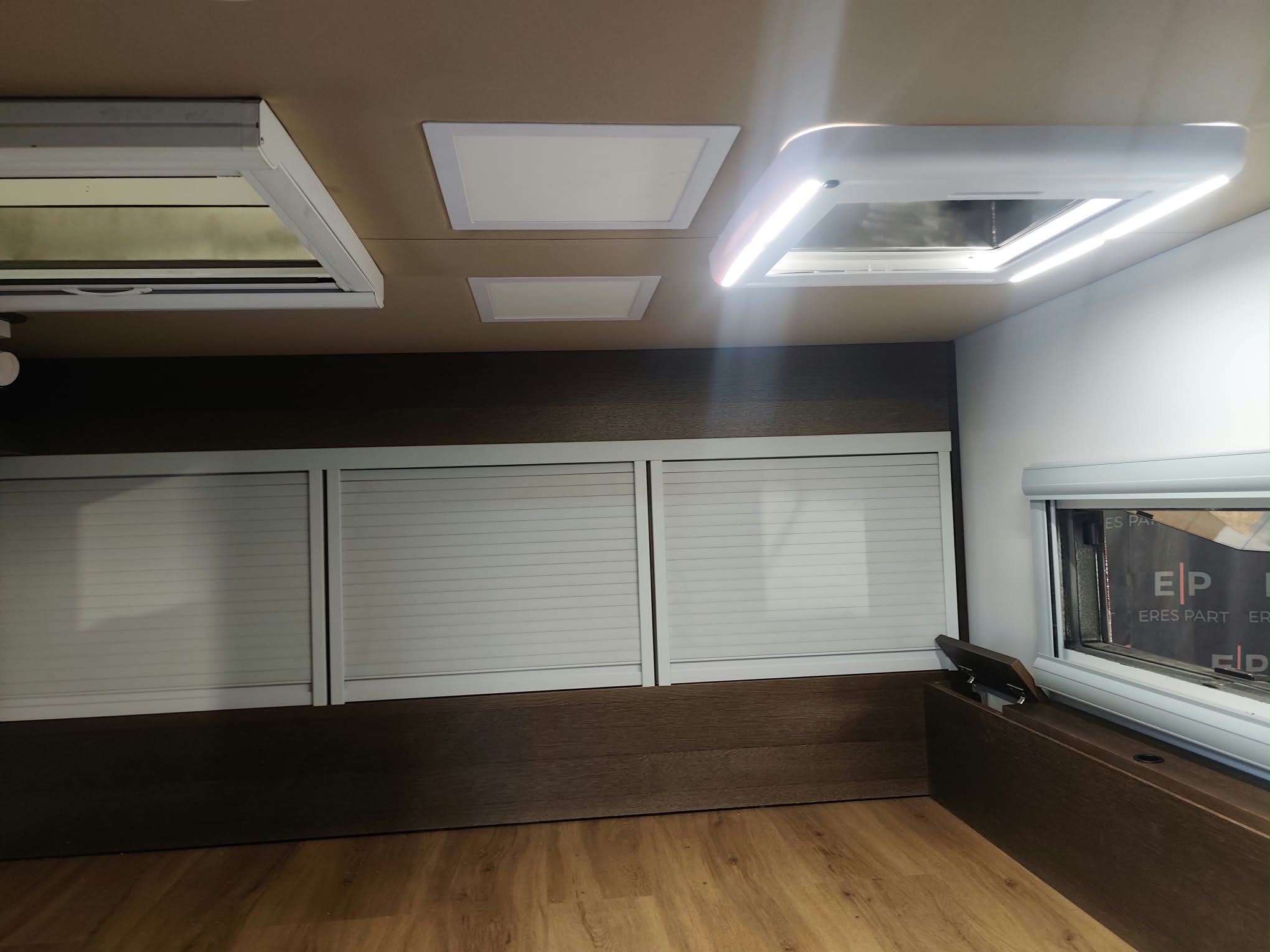
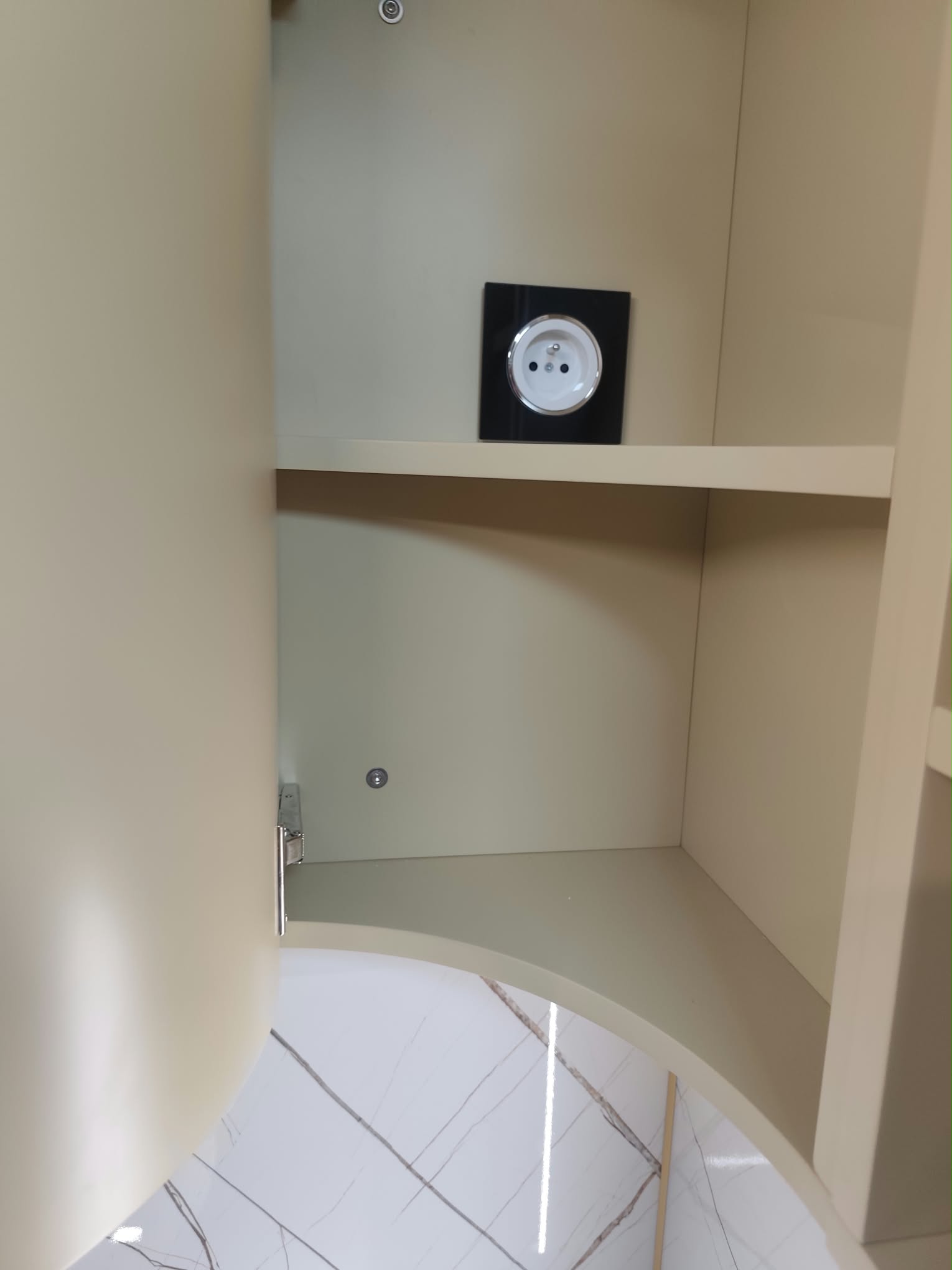
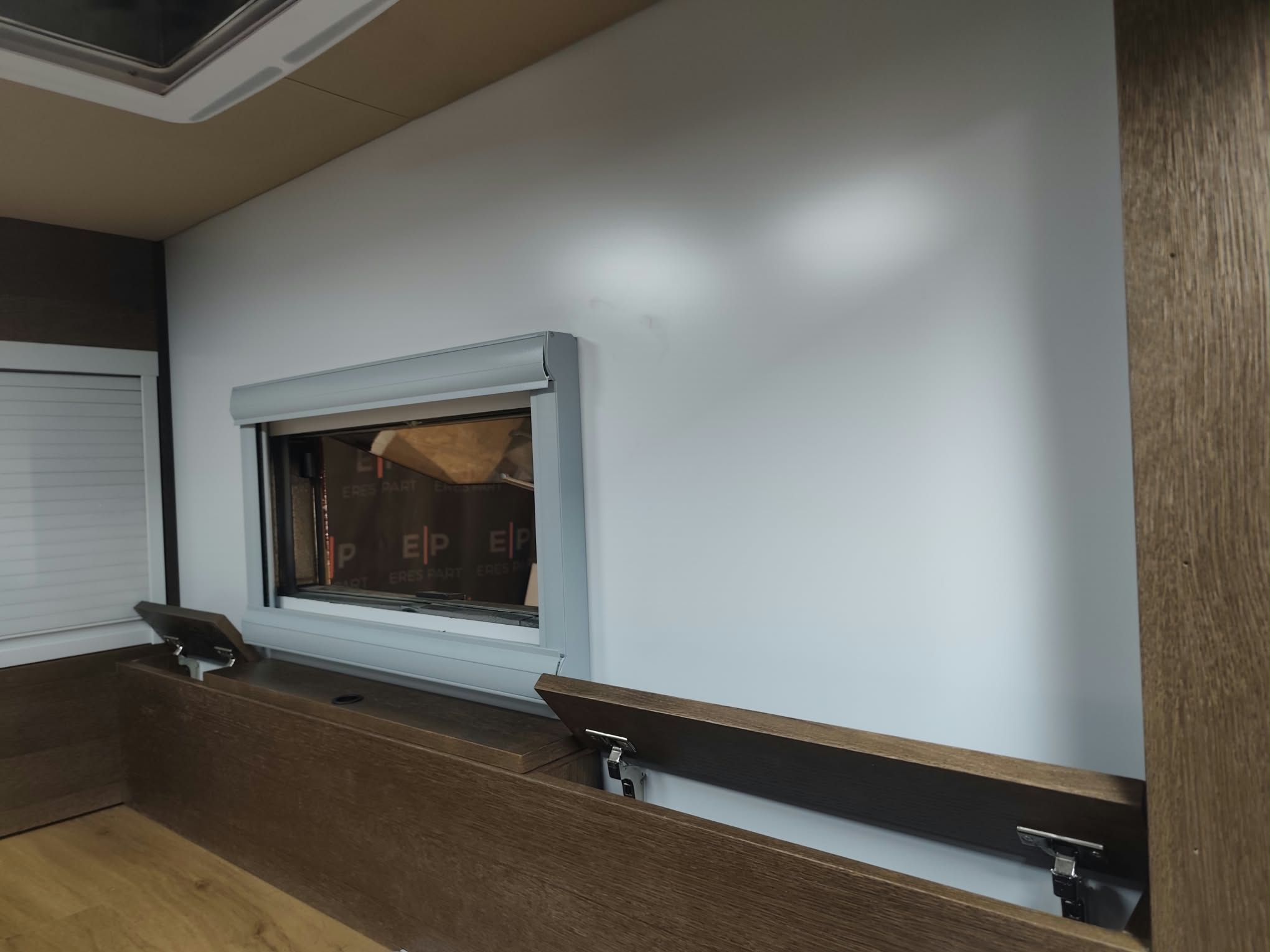
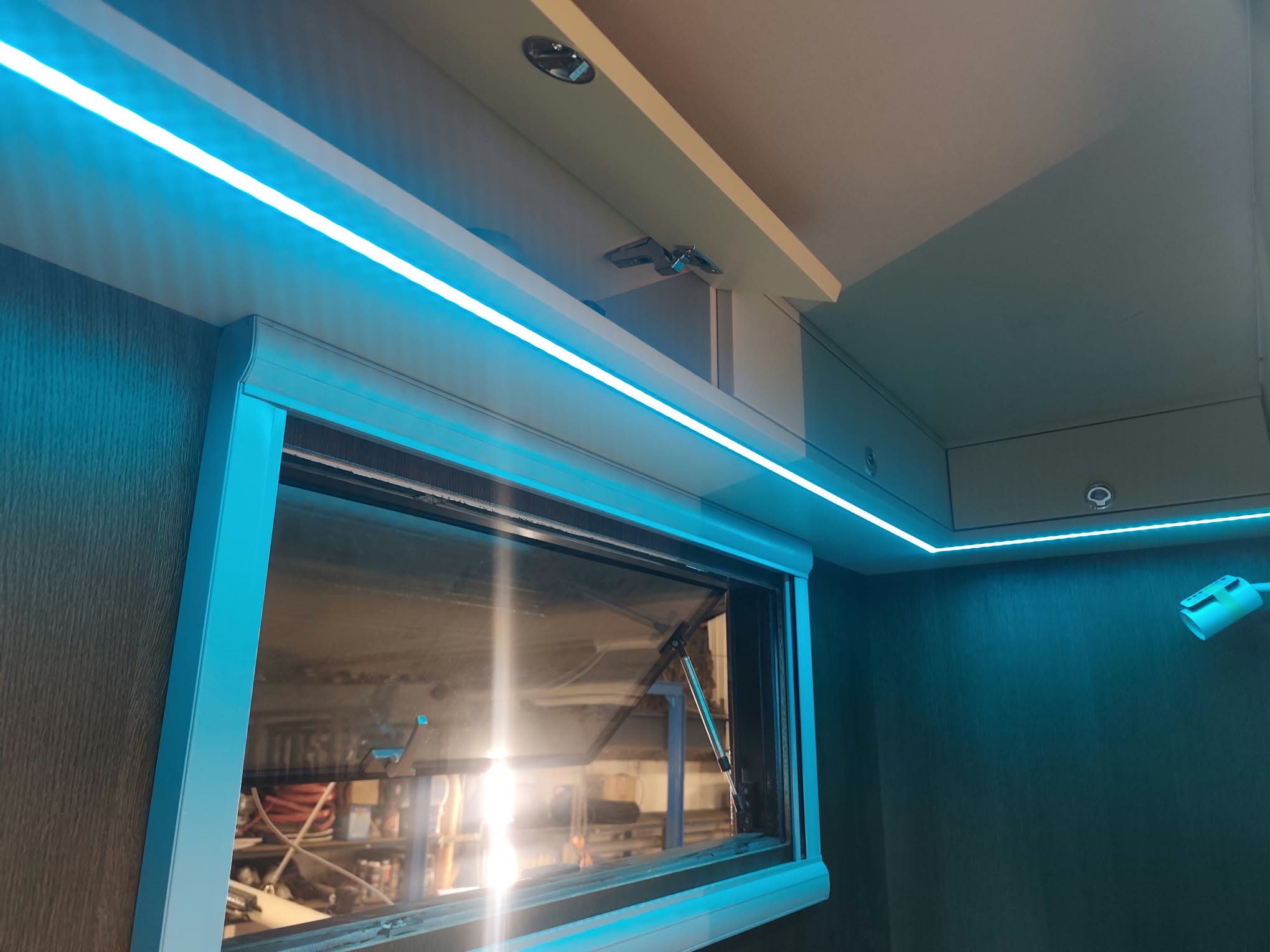
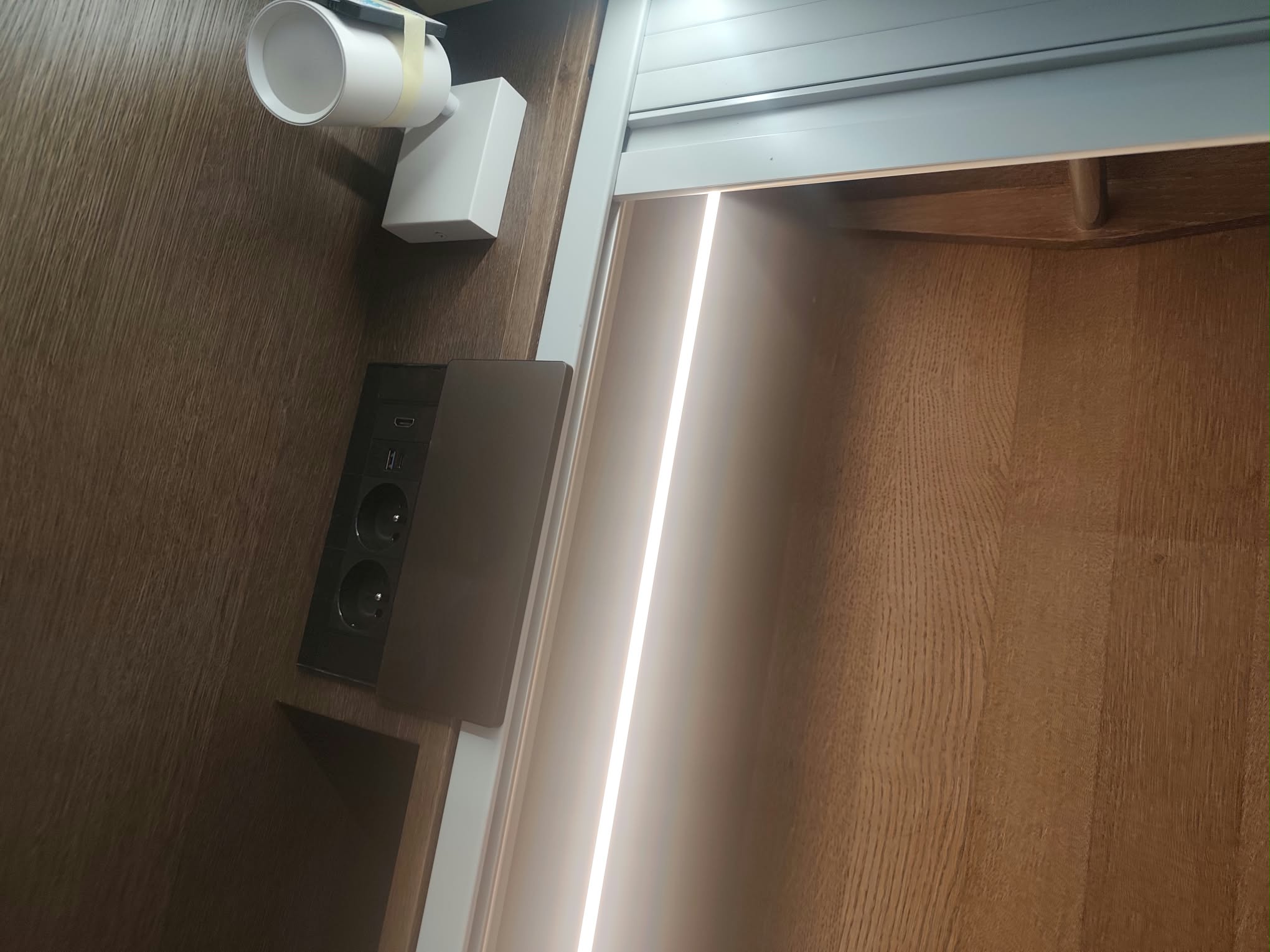
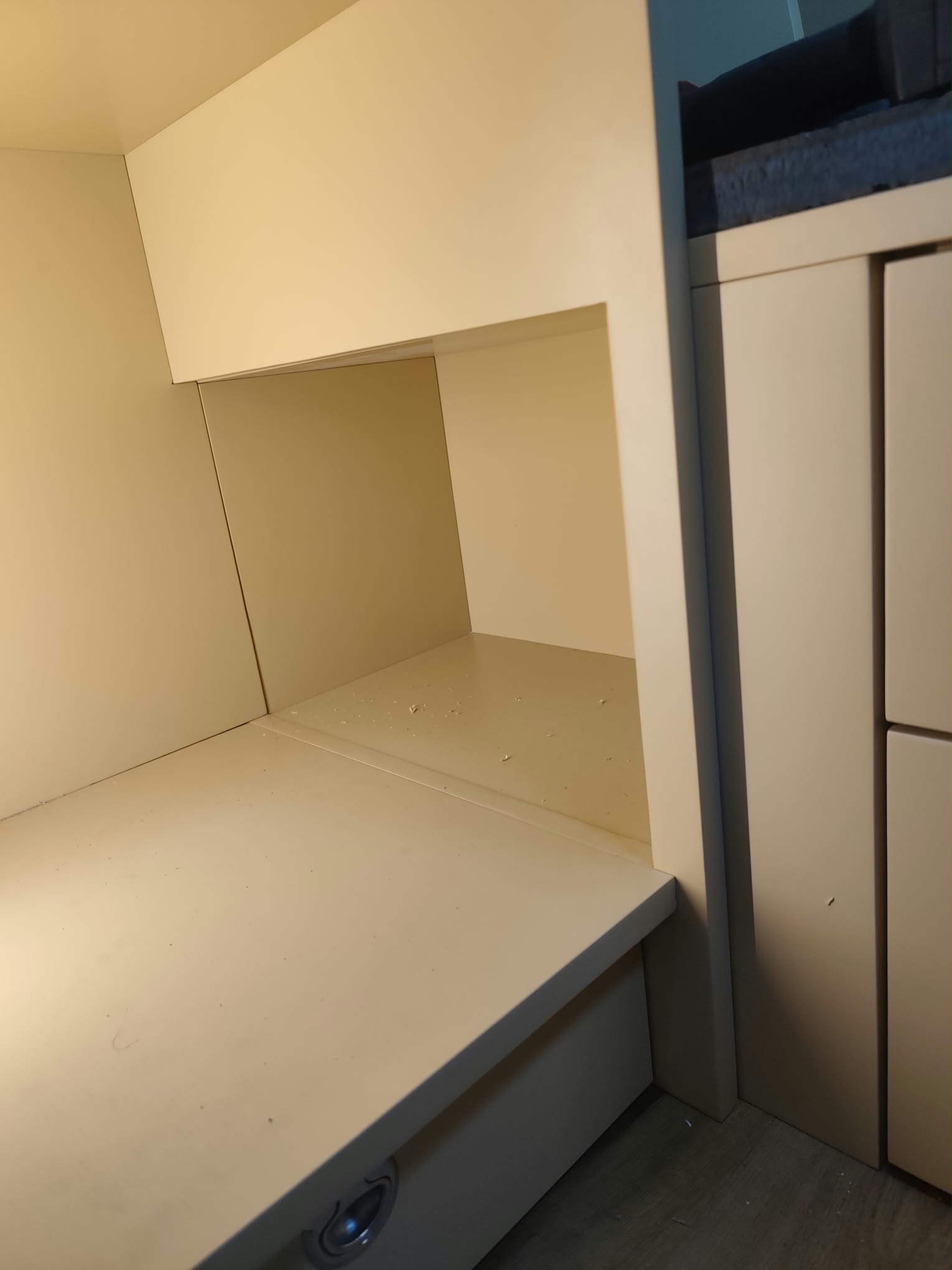
Its thermal envelope begins with 80 mm of insulation — a 40 mm foam sandwich paired with 40 mm of closed-cell XPS, capped by an aluminum plate and a rubber-core panel that absorbs structural flex without compromising the seal. Underfloor water heating in the kitchen, bathroom and bedroom, roof-mounted air conditioning, and a dedicated heating circuit for the traction battery maintain a comfortable internal climate and protect the electric architecture across the full temperature spectrum.
Redundancy is built into the heating philosophy itself. The Meridian draws warmth from five independent sources: waste heat scavenged from the Cummins engine, a Webasto diesel heater, an ALDE electric boiler, thermal energy recovered through regenerative braking, and the air-conditioning unit running in reverse heat-pump mode. If any single source fails, four remain. At −30 °C in the tundra, that redundancy is not a specification — it is survival. The waste system is engineered for frost, with several ways of connecting the waste plumbing — including the air conditioning — working down to −30 °C. MaxxFan Deluxe roof fans in the bedroom and bathroom maintain airflow.
This is not an open space with furniture in it. It is a set of fully closable zones: driver's cab, parents' bedroom, separate berth, kitchen, bathroom with its own enclosed shower, and the technical room. When one person sleeps, another can cook — and cooking smells do not reach the bedroom. That is not a detail. On a long trip it is the difference between a motorhome and a home. Every zone is designed fully for its purpose, not as a compromise squeezed into shared space.
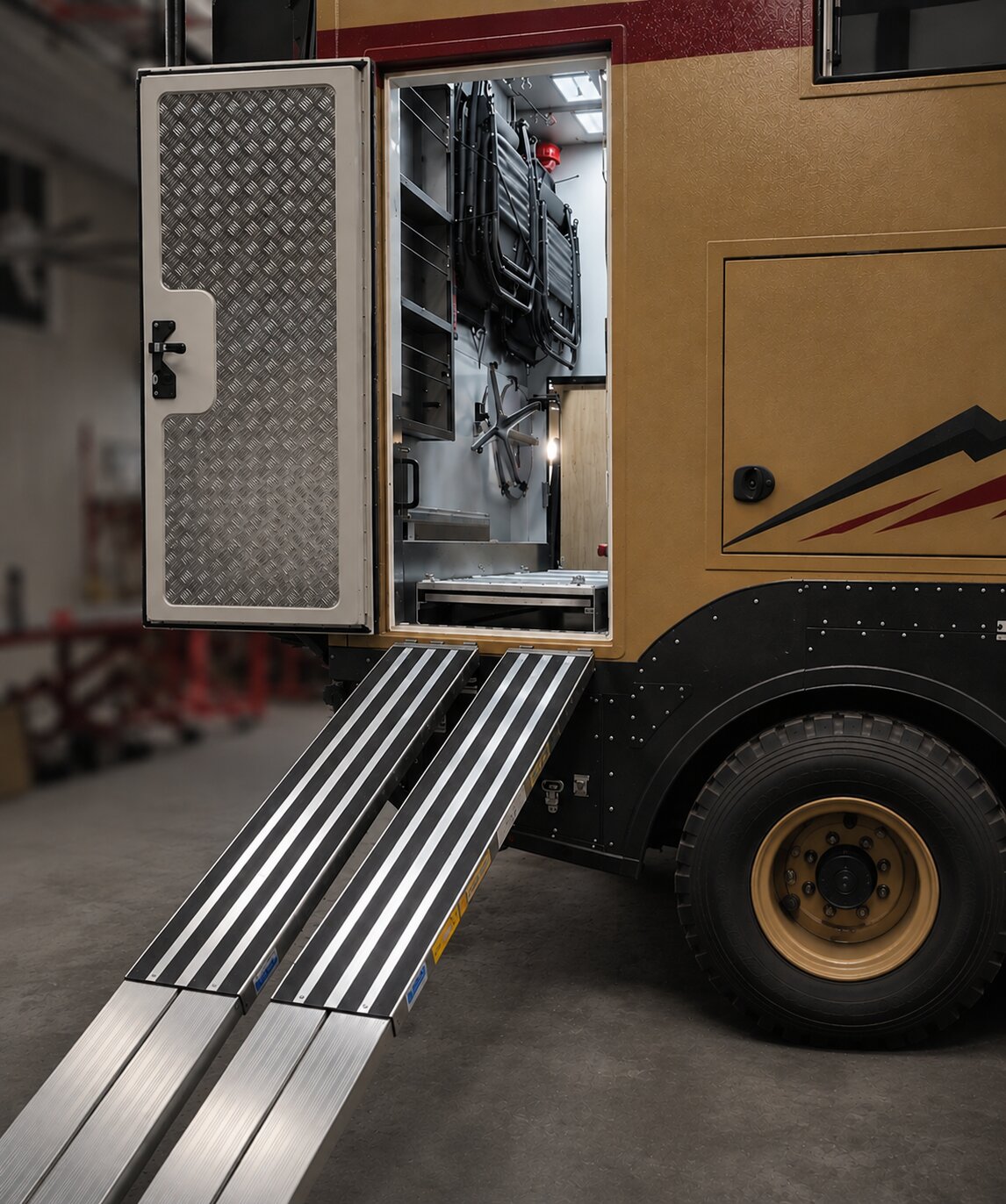
The technical room features a loading ramp and space for three e-bikes, including charging inside. A washing machine and built-in drying racks mean that on a month-long trip you do not need a laundrette. Three televisions — one of them outdoors — and three independent audio zones, including an outdoor speaker, provide entertainment without intrusion.
Onboard Water System
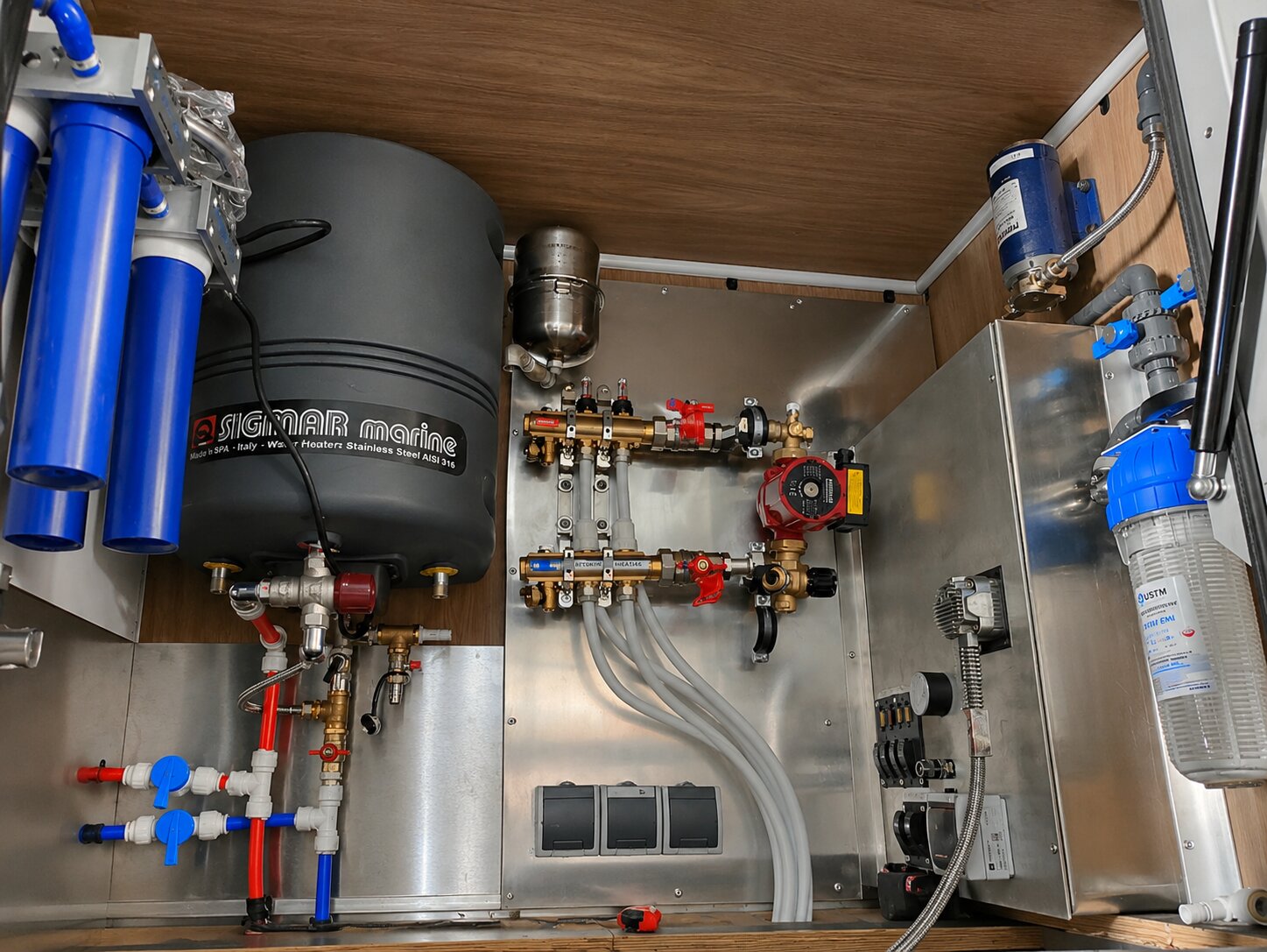
The Meridian carries 330 liters of fresh water, supported by 100 liters of grey and 100 liters of black water storage. But capacity is only half the story. The vehicle does not merely transport water; it manufactures potability. Every drop drawn from a Namibian stream or Siberian lake passes through a four-stage purification chain: mechanical pre-filtration at the inlet, silver-ion treatment inside the tank, activated carbon adsorption, and final UV-C sterilization. The result is not "good enough" water. It is drinking water, produced on demand from sources that would destroy a standard filtration system.
Autonomy means independence from infrastructure, and the Meridian extends that philosophy to hydration. An onboard suction system can draw water from sources up to 30 meters away — whether a mountain stream, a desert well, or a highland lake — without requiring the vehicle to approach the bank. When the rains come, an integrated roof-catchment system harvests runoff, filters debris, and diverts it to auxiliary tanks reserved for washing hands, cleaning boots, or feeding the pressure washer.
A built-in pressure washer with a 10-meter hose reaches the roof. It can run from the vehicle tanks, from collected rainwater, or from an external source. Hot and cold water outlets on the sides of the vehicle allow you to wash the vehicle, the wheels, and the solar panels anywhere — including where there is no infrastructure at all. Between stored reserves, remote sourcing, and atmospheric collection, the vehicle creates a closed water loop that outlasts the fuel autonomy.
Outdoor Living
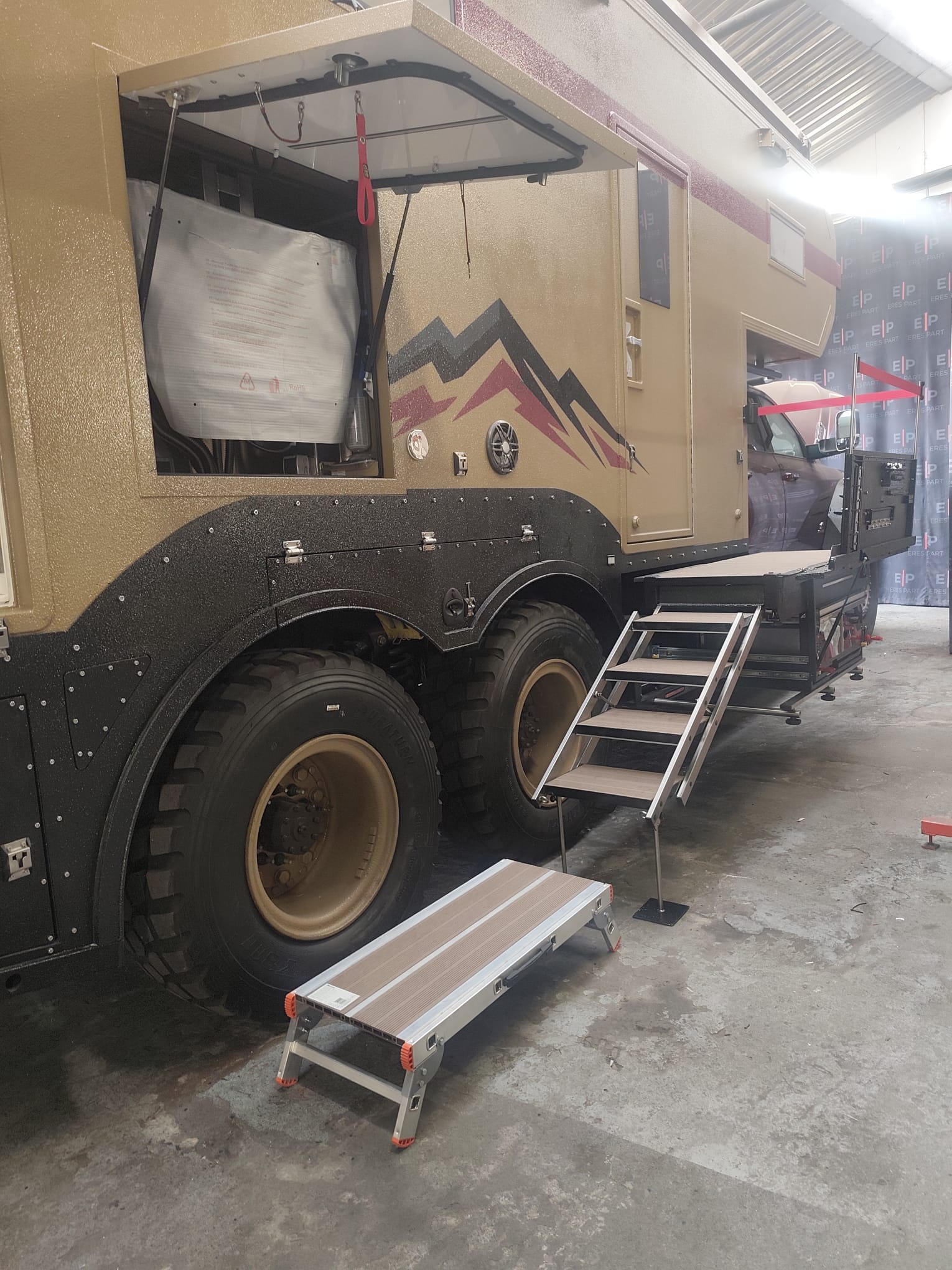
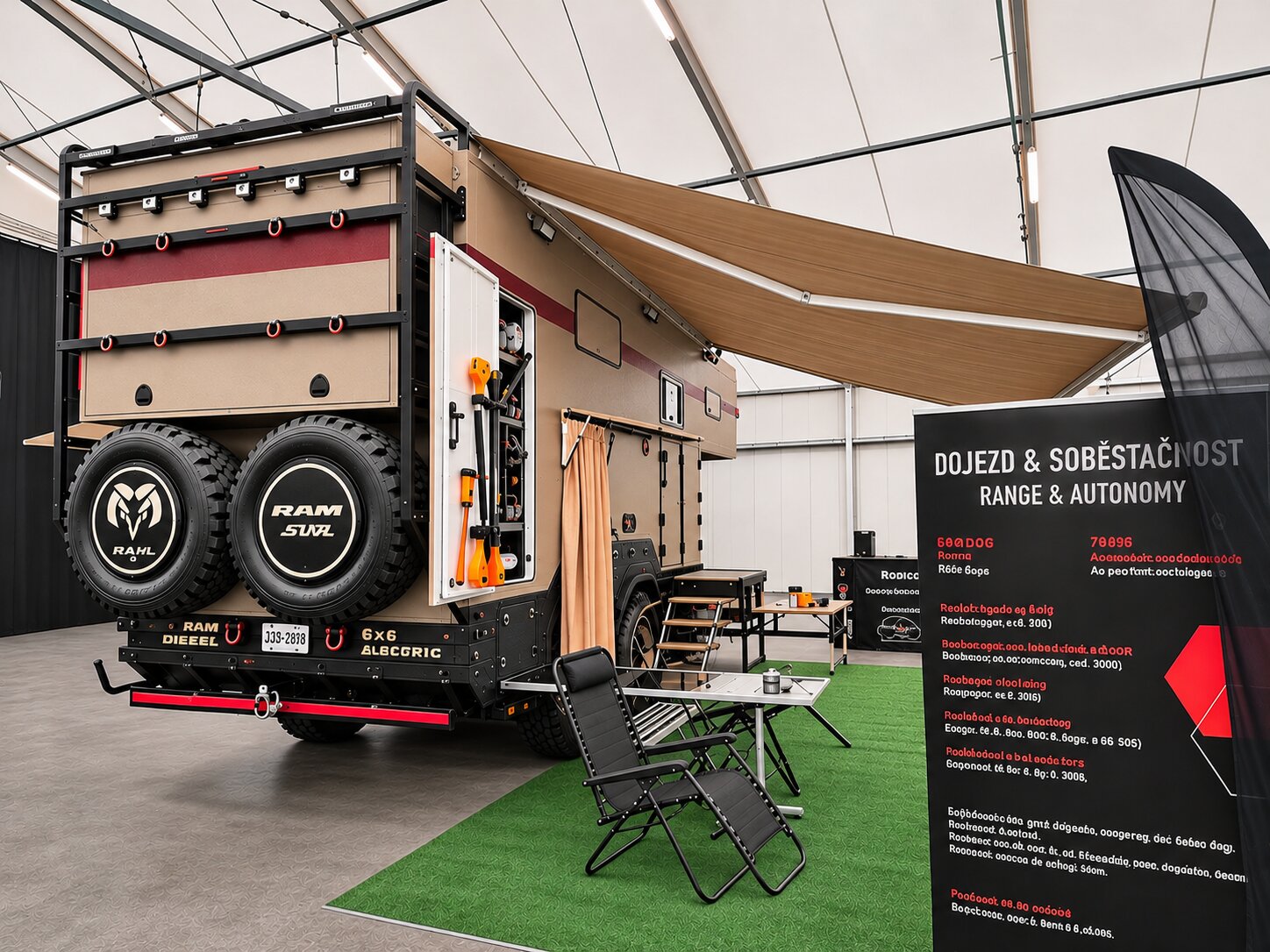
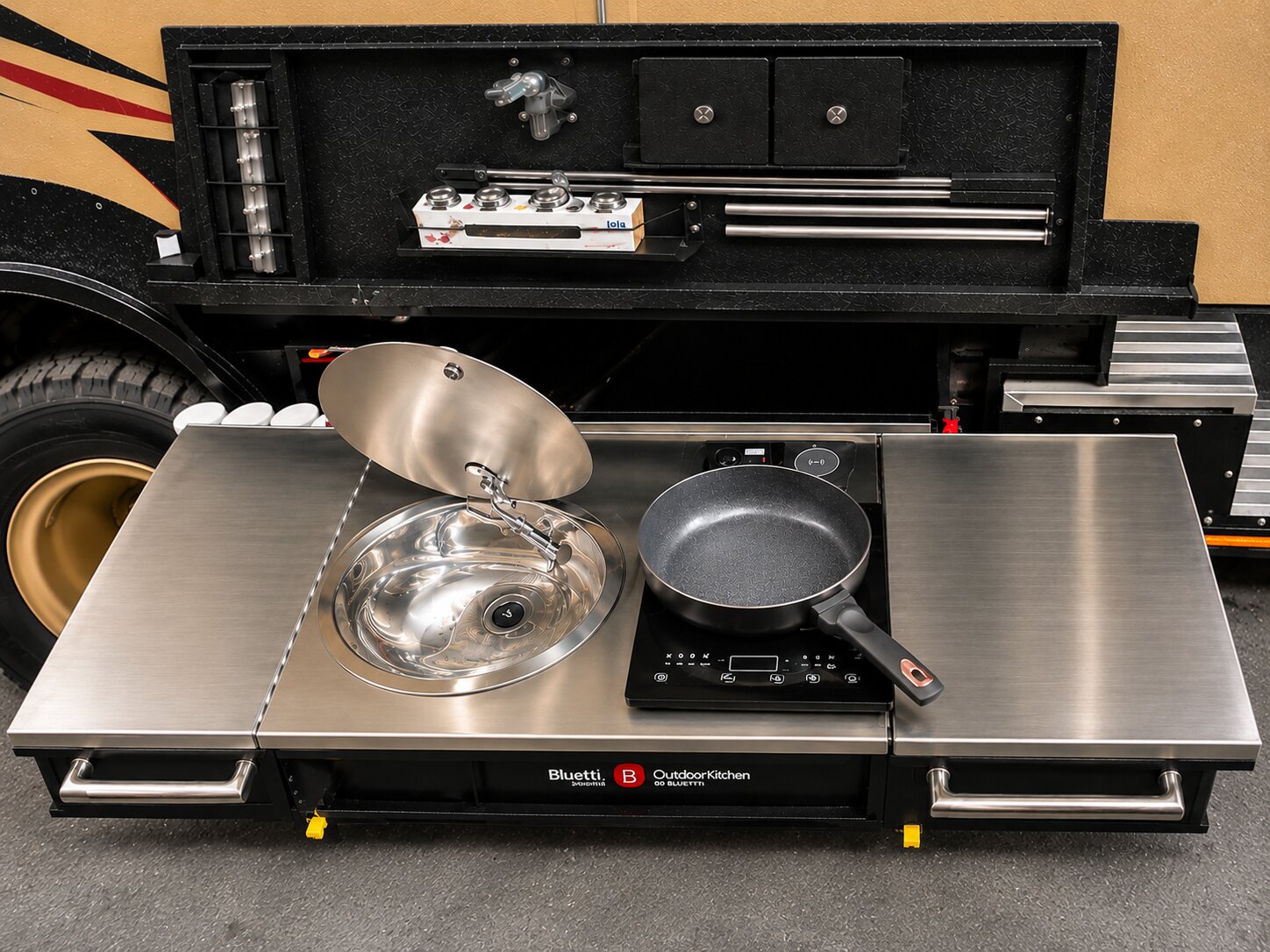
A slide-out entrance platform with railing and stainless steel steps in two configurations — suspended on chains or standing on the ground — creates a proper threshold between habitat and terrain. The outdoor kitchen features a stainless sink, hot and cold water, an induction hob, 230 V and 12 V sockets, USB, wireless phone charging, a network socket and a waterproof speaker. An awning extends 6.5 × 4 meters over an outdoor shower with curtain, a table for four, and four zero-gravity chairs. The boundary between interior comfort and exterior exploration is deliberately blurred.
Recovery
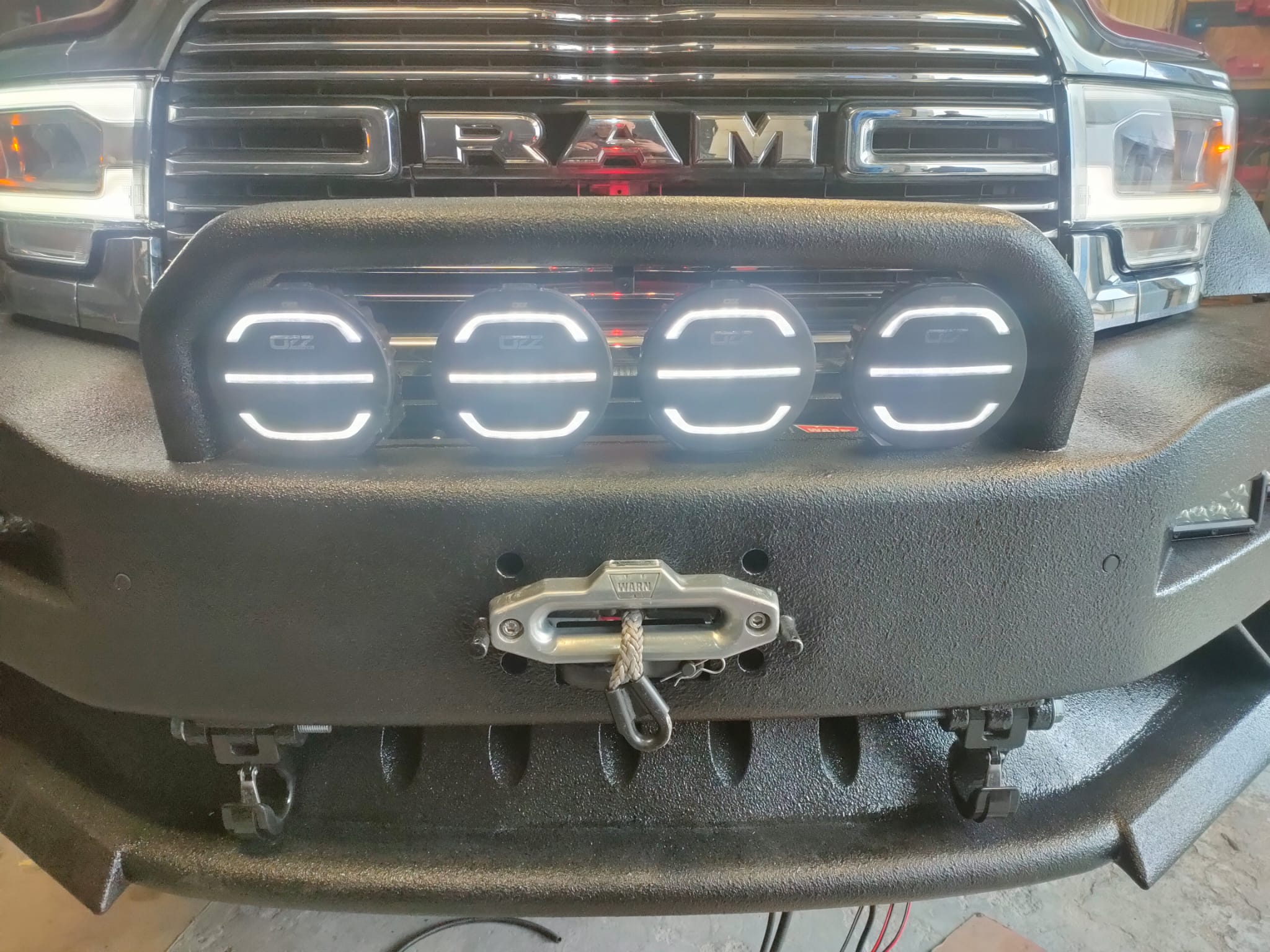
Self-rescue is not an afterthought. A front winch with synthetic Dyneema rope provides primary extraction capability. Seventeen-tonne recovery eyes, a snatch block, and 30-tonne textile anchor slings allow the vehicle to be anchored to trees or rocks when no friendly tow truck is within a thousand kilometers. The electrically raised rear box carrying spare wheels is operable even if the electronics fail, ensuring that a dead battery does not trap your spare under a locked cover.
Situation Awareness
Visibility is safety. A 360° bird's-eye view system provides situational awareness in tight terrain. A separate four-camera HD/IR system monitors the living section independently. Comfort cameras include a forward view from the right mirror into the blind spot, and automatic switching to the front bumper camera under braking. Front parking sensors complete the protective envelope.
Security
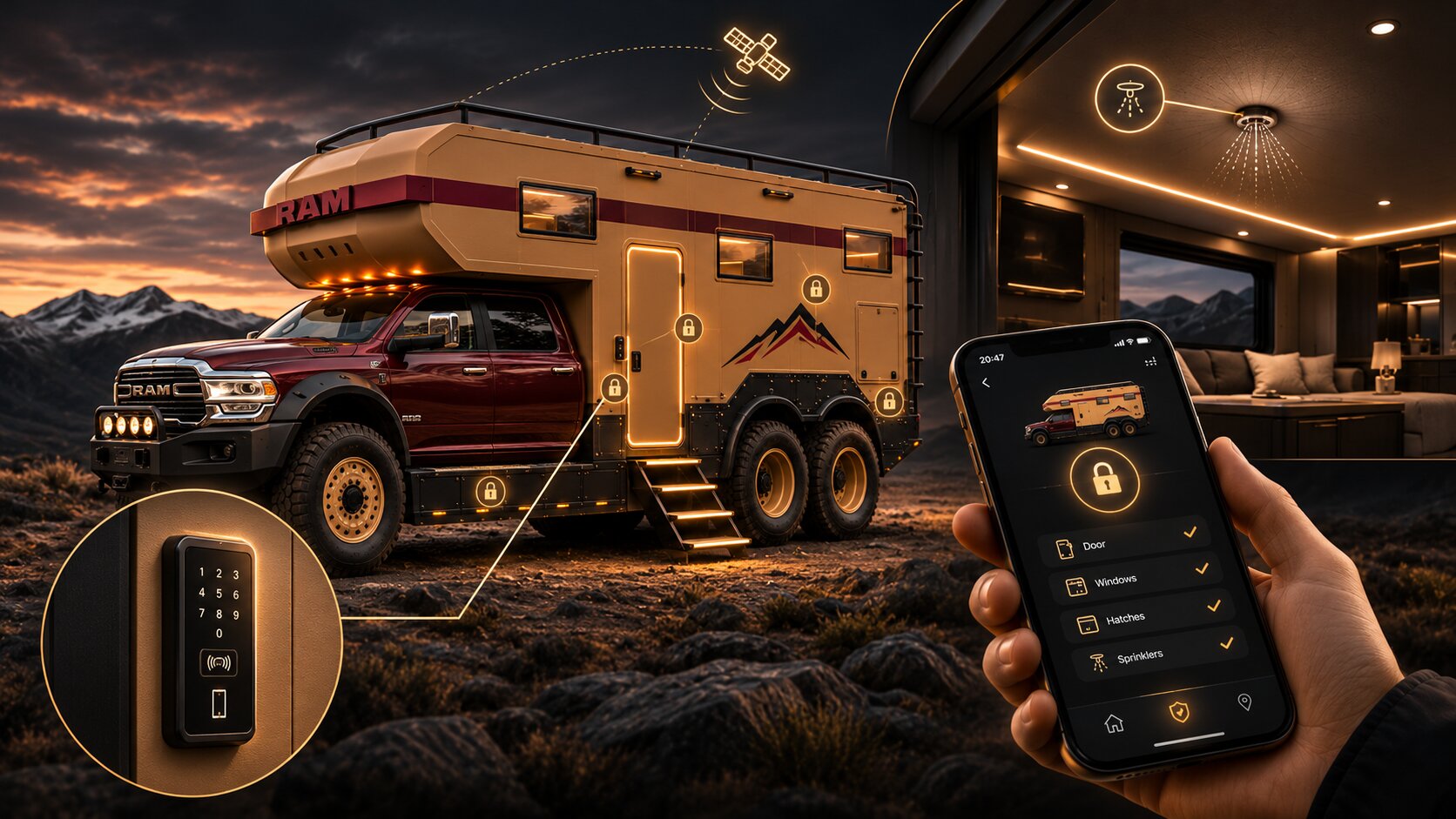
Remote monitoring of every door, hatch and window means you know the vehicle is closed even when you are kilometres away. Sprinklers in the ceiling of the living section provide fire suppression. A smart key safe operates by code, card or mobile app.
Connectivity
Starlink and a 4G/5G router with dual SIM keep the vehicle connected in the most remote locations. Wired internet extends all the way to the outdoor kitchen, so the connection is not limited to the interior.

Lighting
Matrix headlights provide adaptive forward illumination. An LED light bar above the cab switches with the high beams, supplemented by four auxiliary driving lights. Inside, an eight-zone RGBW system creates atmosphere or alert states. Three independent voltage systems — 12 V, 24 V and 230 V — ensure that a failure on one circuit never means darkness throughout the vehicle.
Documentation
The Meridian carries 1000+ pages of technical documentation: a register of every component, a fault catalogue for every system, and a symptom-to-diagnosis-to-action index. The entire library is stored offline on board and interpreted by an onboard AI assistant. Fault codes are decoded inside the vehicle, even where there is no signal. The vehicle carries its own knowledge with it — a local mechanic who has never seen a machine like this receives a precise procedure for the specific fault, drawn from the vehicle's own documentation, not from generic advice. It does not replace a service network. It removes the need to have one.

Onboard AI
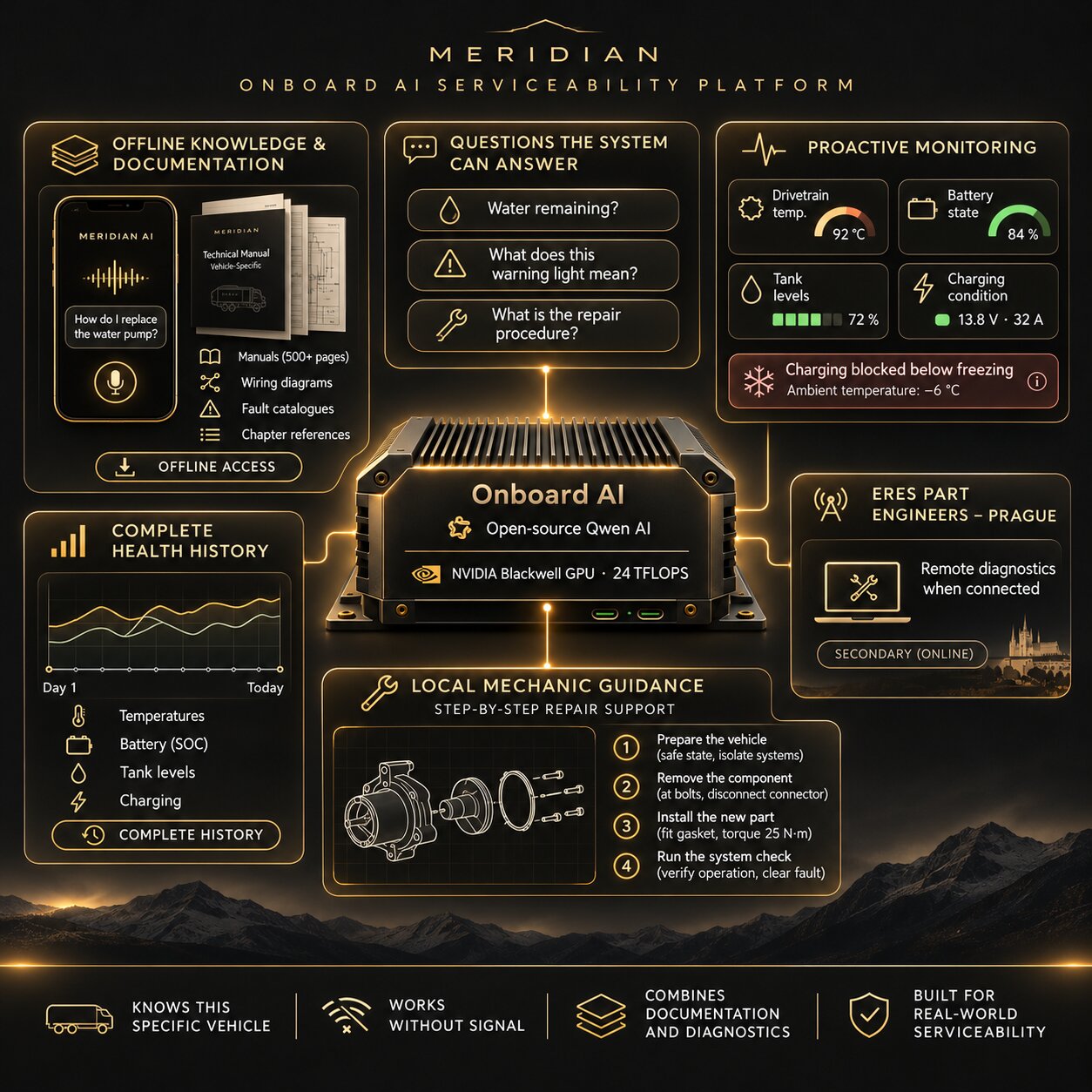
At the core of Meridian’s architecture sits a custom edge computer running open-source Qwen AI on an NVIDIA Blackwell GPU at 24 TFLOPS - an onboard intelligence that knows this specific vehicle, not the internet. It hosts the complete build documentation, wiring diagrams, and fault catalogues for this exact chassis, accessible by voice or smartphone entirely without a signal. Ask it how much water remains, what a warning light means, or how to repair a fault, and it answers with precise chapter references to the technical manual so every instruction can be verified by the crew or any local mechanic.
The system is proactive. It continuously monitors drivetrain temperatures, battery state, tank levels, and charging conditions, raising its own alarms before limits are exceeded—for example, blocking battery charging in freezing temperatures. From day one, it records every operational parameter, building a complete health history. When connectivity is available, ERES PART engineers in Prague can access the platform remotely to review diagnostics, regardless of where the vehicle is located.
This redefines serviceability for extreme expedition vehicles. The Meridian is a one-off; no worldwide dealer network understands it, and in the places it operates, even major brands cannot help. The assistant removes that dependency entirely: it gives a local mechanic step-by-step procedures drawn from the vehicle’s own 500-page documentation, offline and on demand. Unlike anything offered by EarthRoamer, Unicat, or GXV - and far beyond OBD apps that only read engine codes while ignoring habitation, power, and tank systems - the Meridian carries its own expertise with it. The methodology is built to scale: the machine-readable component registry created for this build becomes the foundation for every future vehicle, turning engineering into permanent, portable knowledge.